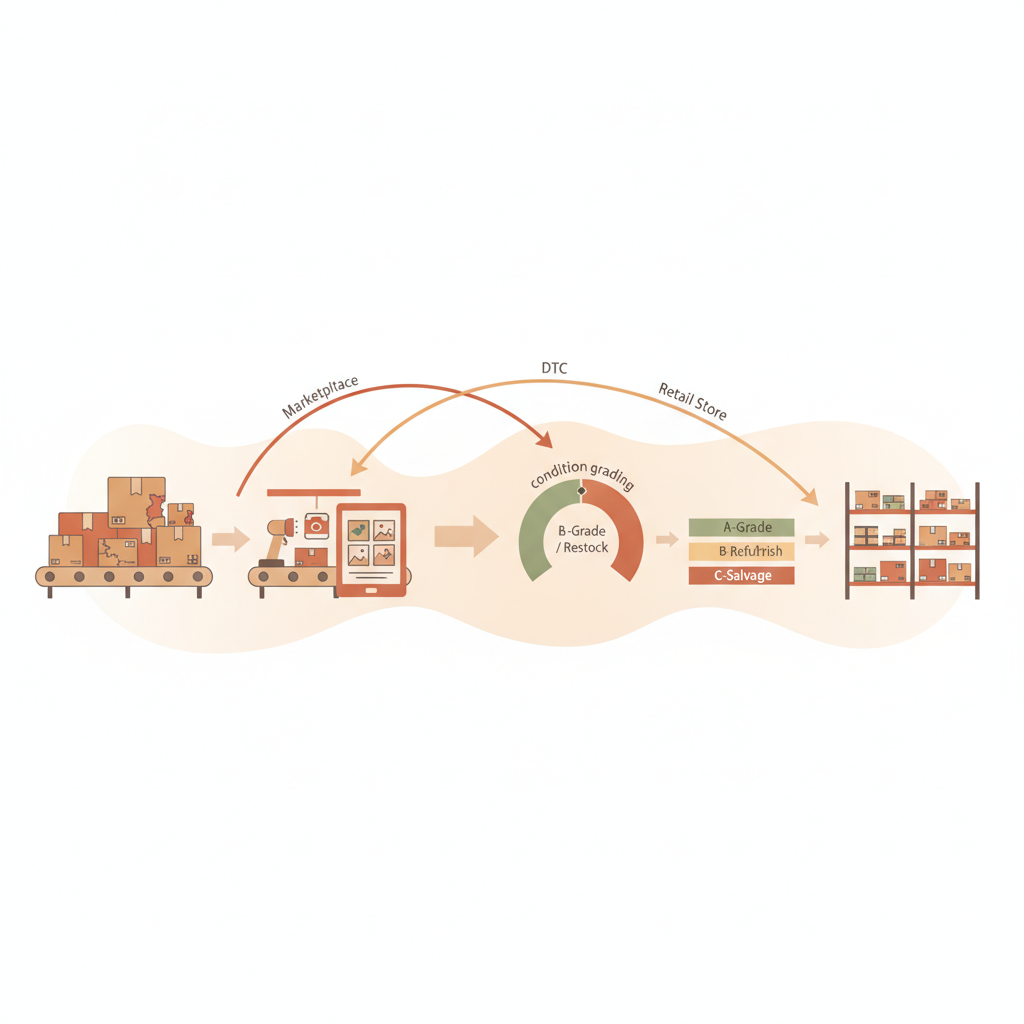
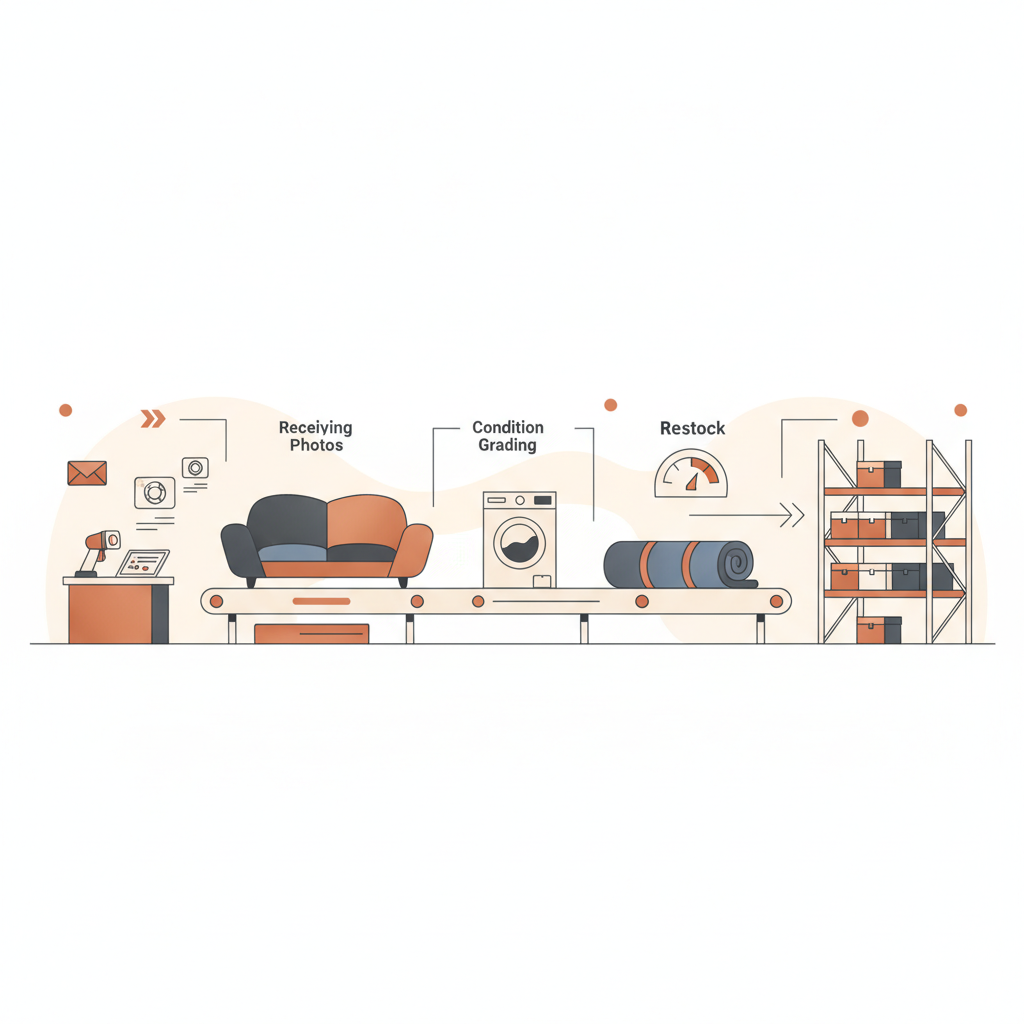
From Scan to Grade: The AI Condition Grading Timeline Explained
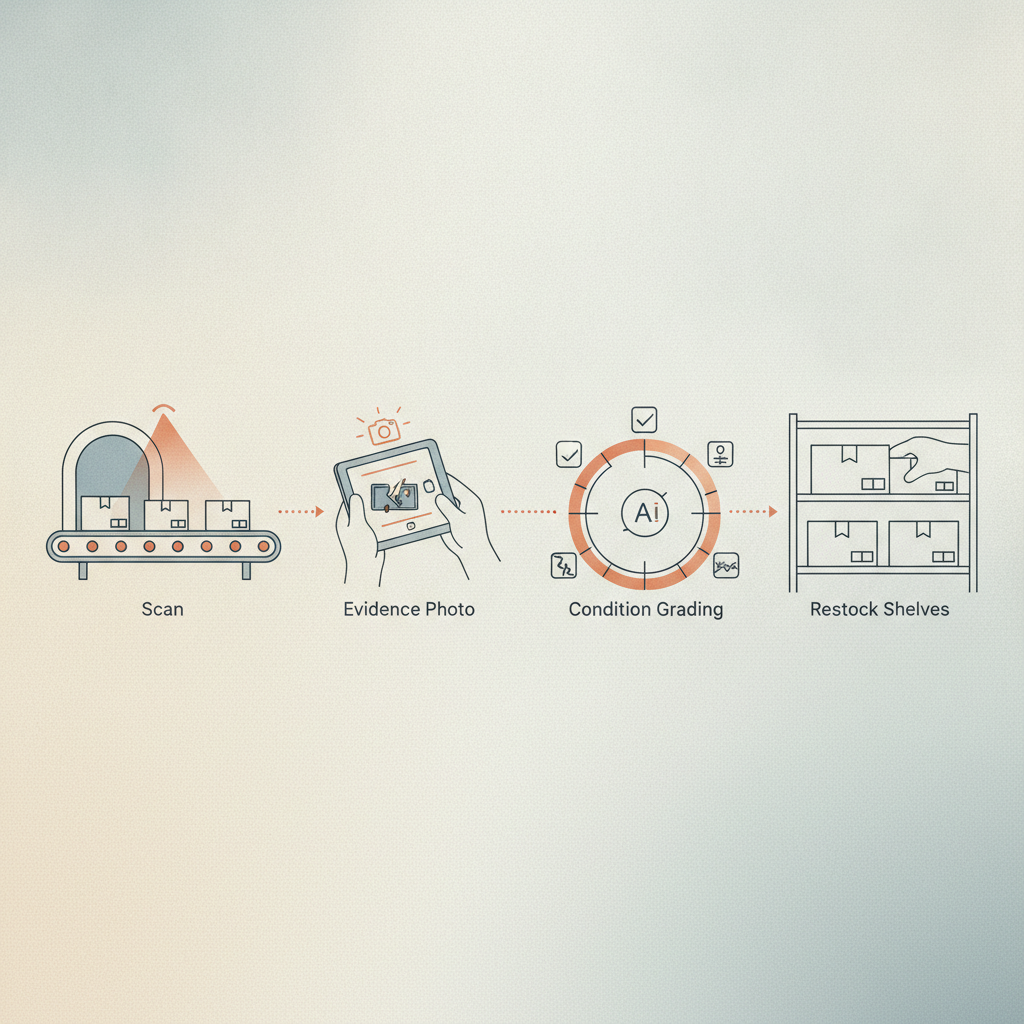
The AI condition grading timeline from scan to grade is the sequence a returned item moves through at areturnz: inbound scan, photo capture, AI grading with a confidence score, disposition routing, and shipment or inventory posting, typically completed in a median of about 48 hours. areturnz treats this window as a measurable pipeline, not a vague promise, because every stage produces a timestamp and a photo that lands in the evidence bundle for that parcel.
What happens between scan and grade
Most returns programs talk about cycle time as a single number and leave it there. That number hides a handful of discrete steps, each with its own failure modes and its own clock. Understanding those steps matters if you are trying to forecast restock velocity, plan liquidation timing, or explain to a brand partner why a grade took six hours instead of six minutes.
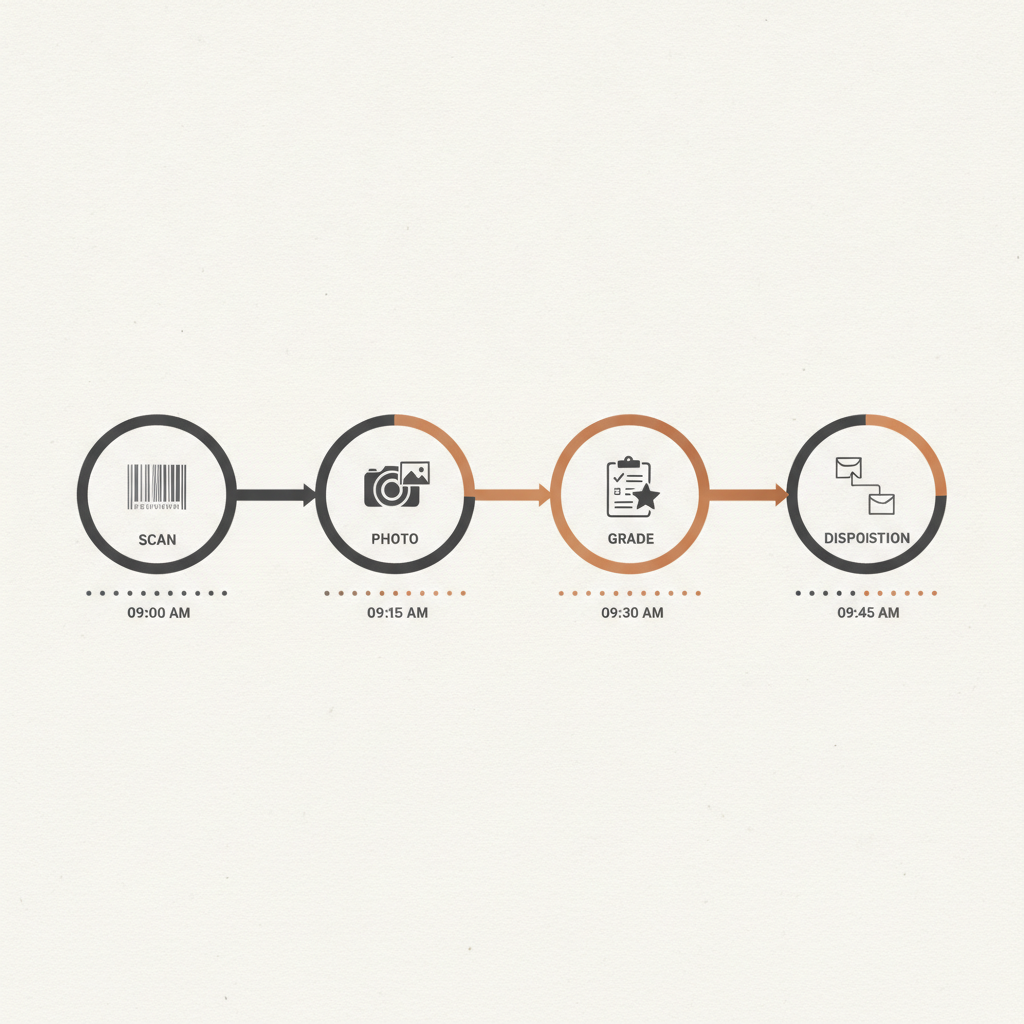
At a high level, a parcel at areturnz moves through five stages: receiving and outer label scan, unboxing and item photography, AI grading against the A/B/C/R scale, disposition routing (with operator override where the rules call for it), and final posting to restock, liquidation, donation, or destruction. The 48 hour median covers all five stages end to end, not just the AI inference step.
The scan-to-grade timeline, stage by stage
The table below breaks down where time actually goes. These are typical ranges across the 180K+ returns areturnz has processed through facility NJ-01 in East Hanover, New Jersey. Individual items can move faster or slower depending on category and condition ambiguity.
| Stage | What happens | Typical duration | Evidence captured |
|---|---|---|---|
| Inbound scan | Outer label scanned, parcel logged against the originating order or RMA | Minutes | Outer label photo |
| Unboxing and photography | Parcel opened, item photographed from multiple angles including any flagged defect | Under 1 hour | Opened parcel photo, item photo, defect photo |
| AI grading | Model assigns an A, B, C, or R grade with a confidence score and detected tags | Seconds per item | Grade, confidence score, tag list |
| Disposition routing | Rules engine applies the grade to a restock, liquidate, donate, or destroy path, with low-confidence or ambiguous cases routed to an operator | Minutes to a few hours | Disposition decision, operator override log if applicable |
| Posting and handoff | Item moves to restock inventory, outbound liquidation lot, donation manifest, or destruction queue | Remainder of the 48 hour window | Final status in evidence bundle |
Why speed does not mean skipping steps
A 48 hour median sounds aggressive until you see that it is an outcome of automation at the grading step, not a shortcut around photography or review. The AI model handles the repetitive visual judgment in seconds. What used to take a human grader several minutes per item, turning an item over, checking for stains or scuffs, cross-referencing a condition policy, now happens in the time it takes to capture the photo set.
The part that still takes operator time is exception handling. Items where the model returns a lower confidence score, or where detected tags conflict with the expected condition, get pulled for a human look before disposition is finalized. That review queue is small by design: areturnz holds a 99.6% AI-vs-operator match accuracy across its graded volume, which means the exception rate is low enough that it does not become the bottleneck.
Where the clock can stretch
Three things commonly add hours rather than minutes: a defect that needs a second photo angle to confirm, a SKU without enough grading history to carry high model confidence, and receiving volume spikes during peak weeks that queue parcels before they reach the photography station. None of these change the grading logic itself. They change how long an item waits for its turn.
For a deeper look at how the confidence score decides whether an item moves straight through or waits for a person, see confidence scores on the grading line, and for what happens when the model gets a grade wrong, see false-positive handling in AI grading.
Where confidence scores fit into the clock
Every grade comes with a confidence score, not just an A, B, C, or R label. High-confidence grades flow straight to disposition rules without a human touch. Lower-confidence grades, or items carrying tags the model flags as ambiguous (a stain that could be a shadow, a scuff that could be packaging residue), get routed to an operator queue. That operator's decision is logged against the original AI grade, which is part of how the 99.6% match rate is tracked over time.
This matters for the timeline because it means the 48 hour median is not a fixed SLA applied uniformly. It is a median across a mix of fast, high-confidence items and slower, reviewed items. If you want the full mechanics of the grading scale itself, the A, B, C, R grading explainer covers how each grade is defined and what tags typically drive a C versus an R.
Scan-to-grade timing versus common alternatives
Manual grading processes and generic 3PL returns add-ons rarely publish a cycle time at all, which makes comparison difficult. The table below lays out the structural difference in how fast a decision gets made, independent of marketing claims.
| Approach | Grading method | Typical time to disposition | Evidence per item |
|---|---|---|---|
| areturnz | AI grading (A/B/C/R) with confidence score, operator override logged | About 48 hours median | Full photo set plus signed evidence bundle |
| Manual grading desk | Human visual inspection against a written condition policy | Days, dependent on staffing and backlog | Inconsistent, often notes only |
| Generic 3PL returns add-on | Basic sortation, limited or no condition grading | Varies widely, rarely tracked as an SLA | Minimal, often none |
If you want to see what the evidence actually looks like for a graded item, the evidence sample page shows a real bundle: photos, grade, confidence score, and disposition in one record.
What slows the timeline down in practice
Peak season volume is the most common stressor on the 48 hour median. More inbound parcels mean more items queued at the photography station before they ever reach the AI model, even though the grading step itself does not get slower. Category mix matters too: electronics with functional checks and apparel with fabric condition nuances sometimes need an extra photo angle that other categories skip.
None of this changes the underlying architecture. The timeline is built around the model doing the fast, repetitive work and operators doing the judgment calls the model flags as uncertain. That split is also what keeps the AI and grading pillar consistent across apparel, electronics, and beauty categories, each of which has its own detected tag vocabulary but the same scan-to-grade structure.
Frequently asked questions
What is the AI condition grading timeline from scan to grade?
It is the sequence of steps a returned item goes through at areturnz: inbound scan, unboxing and photography, AI grading with a confidence score, disposition routing, and final posting. The full sequence runs at a median of about 48 hours.
Does a faster grading timeline mean lower accuracy?
No. The AI grading step itself takes seconds because the model is doing pattern recognition on photos, not because steps are skipped. Accuracy is tracked separately through a 99.6% AI-vs-operator match rate, and low-confidence items are routed to a human reviewer before disposition.
Why do some items take longer than 48 hours to grade?
Items with ambiguous defects, categories with thinner grading history, or parcels arriving during peak volume weeks can queue longer at the photography or review stage. The grading logic does not change. The wait time before an item reaches that stage does.
Can partners see the timeline for their own returns?
Yes. Every parcel's evidence bundle includes timestamps for scan, photography, grading, and disposition, available in the dashboard and via the signed-JSON API with webhooks. Partners evaluating this for a white-label program can review the partner use case page and pricing for how cycle time factors into SLA commitments.
Does the timeline differ by product category?
Yes, slightly. Apparel, electronics, and beauty items each have different tag sets the model checks for, which can add or remove a photo angle, but the overall scan-to-grade structure and the 48 hour median apply across categories.
Want to see how this timeline would run against your own return volume? Contact areturnz to walk through a sample evidence bundle and a cycle time estimate for your category mix.
Proof on every return
Photos, an AI condition grade, and a full custody chain, attached to every parcel and available via the API.