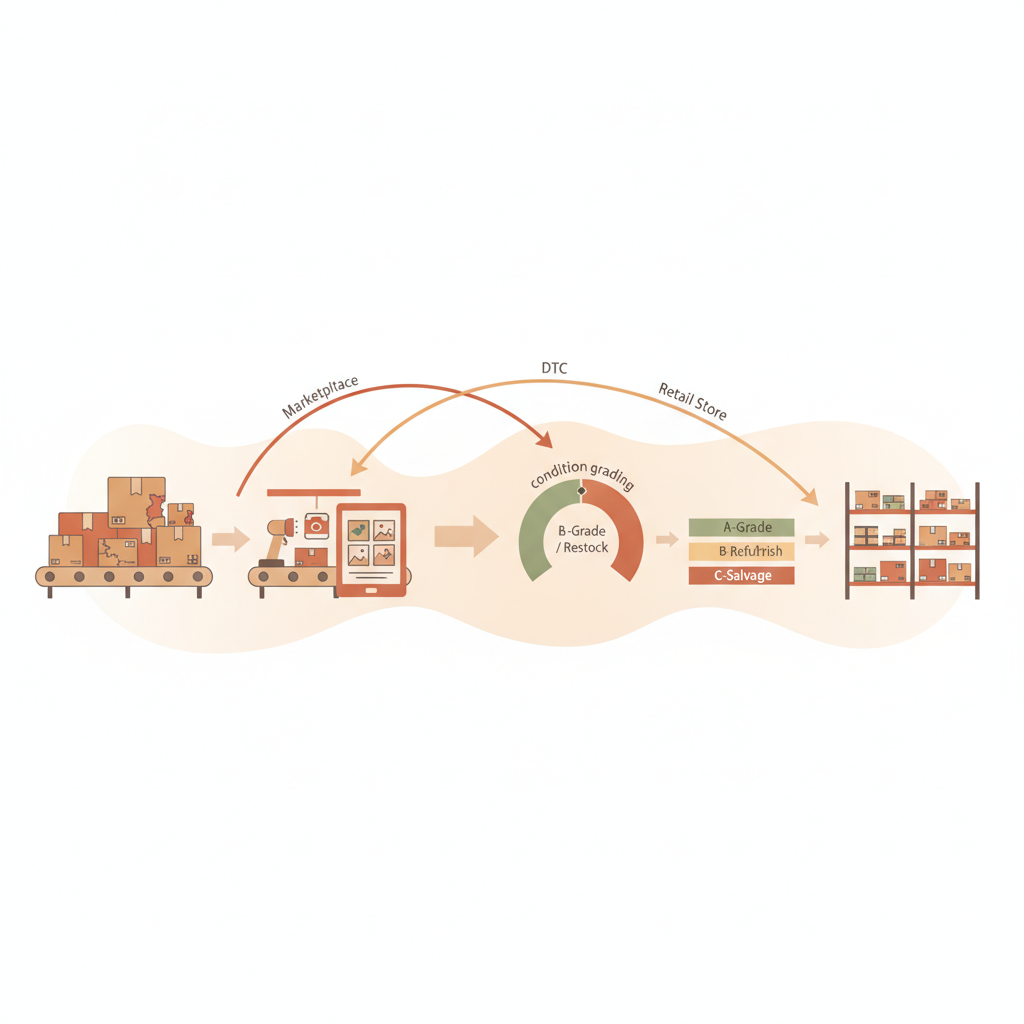
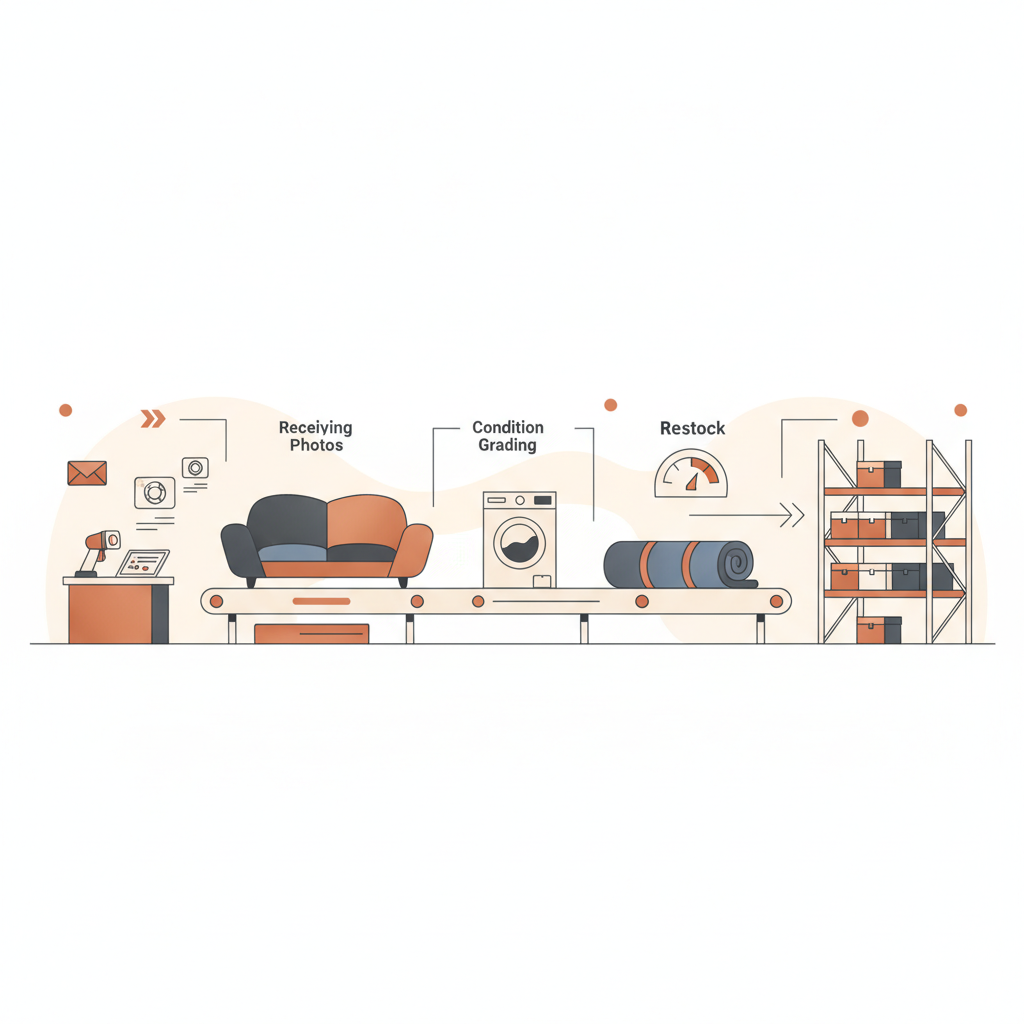
Real-time grading vs batch grading: operational tradeoffs at scale
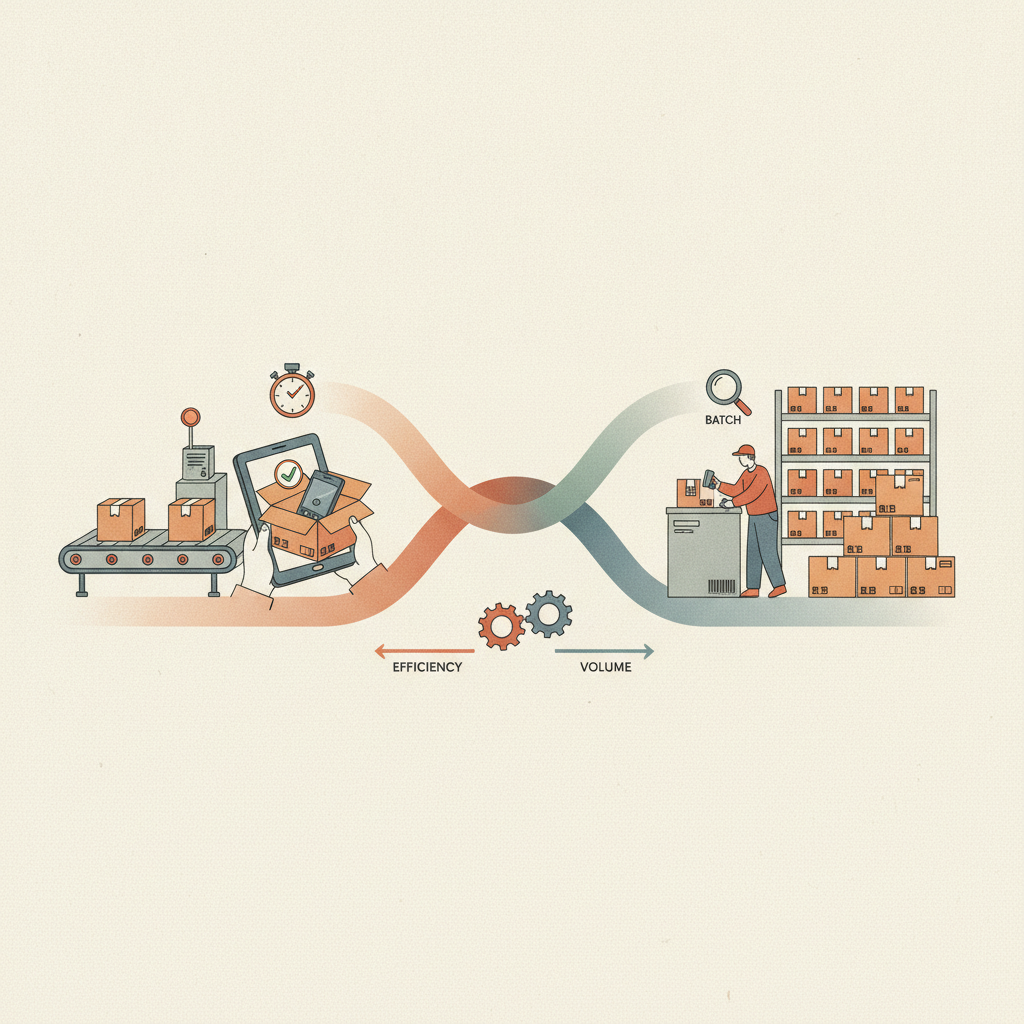
Real-time grading means an AI model scores a returned item's condition (A, B, C, or R) the instant it is photographed at receiving, so disposition can start within seconds. Batch grading means items are photographed and queued, then scored together in scheduled runs, often minutes or hours later. areturnz runs real-time grading across its network because the gap between the two approaches compounds directly into cycle time: it is a large part of how the network holds a roughly 48 hour median cycle from inbound scan to disposition across 180K+ returns processed.
The choice between the two is not just a technical preference. It changes staffing models, how fast inventory re-enters sale channels, how disputes get resolved, and what a facility can promise a partner in an SLA. Most returns operations that scaled past a single pilot facility have run into this decision at some point, usually when volume outgrows whatever grading process was good enough at a smaller scale.
What real-time grading actually does on the line
In a real-time setup, the camera capture at receiving (outer label, opened parcel, item, defect close-up) feeds directly into the grading model as each parcel is processed. The model returns a grade and a confidence score before the next parcel reaches the station. If confidence is high, disposition logic fires immediately: restock, liquidate, donate, or destroy. If confidence is low, the item routes to a human reviewer without the rest of the line stalling.
This is the architecture behind areturnz's AI and grading pipeline, and it is why the network can sustain a 99.6% AI-versus-operator match accuracy without slowing receiving down to wait for a nightly job. Every grade, override, and confidence score lands in the evidence bundle tied to that parcel, so the real-time decision is auditable later even though it happened in seconds.

What batch grading looks like instead
Batch grading groups photographed items (by shift, by SKU category, or by a fixed time window) and runs the model against the whole set at once, typically on a schedule: every two hours, once per shift, or once overnight. It is a common pattern for operations that bolted AI grading onto an existing warehouse management system rather than building grading into the receiving workflow itself.
Batch has real advantages in certain contexts. It can be cheaper to run computationally since the model processes a large set in one pass instead of staying warm for continuous single-item inference. It is also simpler to schedule around existing shift patterns and legacy systems that already expect end-of-day data dumps. The tradeoff is that every item in the batch inherits the batch's latency, even the ones that were scanned at 8am and did not need to wait until the 6pm run.
Where the tradeoffs actually bite
At low volume, the difference between real-time and batch grading is mostly invisible. At scale, it shows up in four places: cycle time, disposition responsiveness, dispute readiness, and cost per unit.
| Factor | Real-time grading | Batch grading |
|---|---|---|
| Typical added latency per item | Seconds to a few minutes | Minutes to a full shift or more |
| Effect on cycle time | Supports sub-48-hour median cycles | Adds a fixed delay layer on top of receiving |
| Confidence routing | Low-confidence items flagged immediately for review | Low-confidence items sit until the next batch run before review |
| Restock speed for A-grade items | Can re-list same day | Re-listing tied to batch schedule, not item readiness |
| Dispute evidence turnaround | Grade and confidence available as soon as parcel is logged | Grade not attached to evidence bundle until batch completes |
| Compute cost pattern | Continuous inference, higher steady-state cost | Bursty inference, cheaper per unit at idle times |
| Best fit | High-volume networks where restock speed drives margin | Lower-volume or back-office operations where delay is tolerable |
Why cycle time is the real cost, not the grading itself
The grading computation itself is fast either way. What batch grading actually costs is the waiting. If a facility processes several thousand parcels a day and batches run every four hours, the average item loses two hours just sitting in a queue before it is even scored, before disposition, before restock or liquidation even starts. That delay stacks on top of pick, pack, and ship timelines, and it shows up downstream as slower restock velocity and more markdown decay on items that could have been back on shelf same-day.
Real-time grading removes that queue. A parcel scanned at 9am can be graded, disposed, and routed by 9:05. Multiply that across 180K+ returns and the aggregate time saved is the difference between a network that can promise a 48 hour median cycle and one that can only promise a vague a few days.
Confidence scores matter more in real-time environments
Batch grading can still produce a confidence score per item, but the operational value of that score depends on how fast a human can act on it. If a low-confidence R-grade item sits in a batch queue for six hours before a reviewer sees it, the facility has effectively built in a six-hour blind spot on anything the model is unsure about. Real-time grading pushes low-confidence items into a review queue the moment they are flagged, which keeps the 99.6% AI-versus-operator match rate meaningful: the rate reflects decisions that were actually reviewed promptly, not decisions reviewed long after the item has already moved.
When batch grading is the right call anyway
Real-time is not automatically better for every operation. A facility with low and predictable volume, where restock speed does not change revenue much, can run batch grading without losing anything meaningful. Batch also makes sense as a transitional step: a facility migrating from manual grading to AI grading often pilots with batch runs first, validates the model's accuracy against operator decisions on a known data set, and only moves to real-time once that calibration is trusted. That is a reasonable sequence, not a shortcut.
The line to watch is volume growth. Once parcel counts climb into the thousands per day and the business is tracking restock speed or markdown decay as a margin lever, the batch delay starts costing real money, and that is usually the point operations teams revisit the architecture.
How this plays out across facilities
areturnz's NJ-01 facility in East Hanover, New Jersey runs real-time grading on the receiving line, with every photographed parcel (label, opened parcel, item, defect) scored and routed before the next unit arrives at the station. Disposition rules apply the grade automatically, and any operator override is logged against the original AI grade, which is part of how the network holds its match accuracy over time. That evidence, including the grade, confidence score, and any override, is available in the dashboard and via signed-JSON API with webhooks, so partners can pull grading data into their own systems instead of waiting on a batch export. For a look at what that evidence actually contains, see the evidence sample.
Frequently asked questions
Is real-time grading always more accurate than batch grading?
Not inherently. The model itself can be identical in both setups. What changes is how quickly low-confidence results get human attention. Real-time grading tends to produce better operational accuracy over time because flagged items are reviewed and corrected faster, which feeds back into model calibration sooner.
Does real-time grading cost more to run than batch grading?
Usually, yes, on a pure compute basis, since the model stays active continuously rather than running in scheduled bursts. In practice the added compute cost is small compared to the cycle-time and restock-speed gains at any meaningful volume.
Can a facility switch from batch to real-time grading without disrupting operations?
It is possible but it requires reworking the receiving line so photo capture feeds the model directly instead of into a staging queue. Facilities often pilot this on a single category or SKU set before rolling it out network-wide.
How does grading speed affect disputes with retailers or marketplaces?
Faster grading means the evidence bundle (grade, confidence score, photos) is complete sooner, which shortens how long a dispute can drag on. Real-time grading means that evidence exists almost as soon as the parcel is received, rather than appearing hours later after a batch run completes.
Where does grading fit into the overall returns process?
Grading sits between receiving and disposition. For the full picture of how AI grading and the ABCR system work end to end, see the AI and grading pillar guide.
Want to see how real-time grading performs on your own return volume? Contact areturnz to talk through your current cycle times and where a real-time grading architecture could close the gap.
Related reading: From Scan to Grade: The AI Condition Grading Timeline Explained
Proof on every return
Photos, an AI condition grade, and a full custody chain, attached to every parcel and available via the API.