Destruction Certificates and Duty Drawback: Closing the Compliance Loop
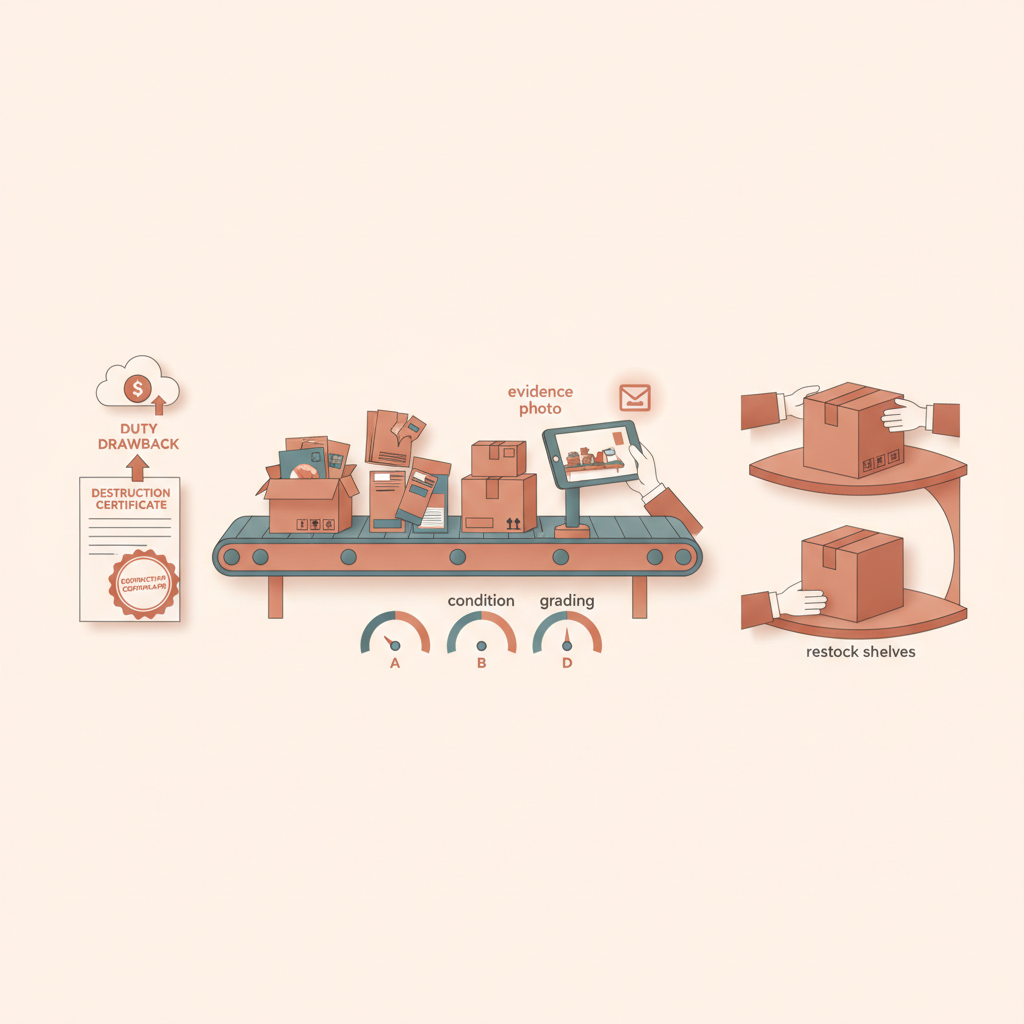
A destruction certificate is a documented, timestamped record proving that a specific unit of returned inventory was physically destroyed rather than resold, and it is the single most important piece of paper (or signed JSON) a finance team needs to support a duty drawback claim. areturnz generates that record automatically for every parcel routed to destruction, tying it back to the original inbound scan, the AI grade, and the photo evidence captured at receiving, so customs brokers and auditors get a chain of custody instead of a spreadsheet promise.
Most returns programs treat destruction as an afterthought: a pallet gets shredded, someone signs a form, and the paperwork sits in a folder until an auditor asks for it. That gap is exactly where duty drawback claims get denied or delayed, because U.S. Customs and Border Protection, and equivalent authorities elsewhere, want proof that the goods were actually destroyed, not just marked as such in an internal system.
Why destruction certificates matter for compliance
Duty drawback lets importers recover duties paid on goods that are later exported or destroyed instead of sold domestically. The claim itself is a tax filing, and tax filings get audited. If your destruction record is a one-line note in an ERP system with no photo, no timestamp, and no operator sign-off, it will not hold up when a customs auditor pulls the file years later.
A defensible destruction certificate needs a few things in place at the same time: proof the item existed and matched the SKU on the drawback claim, proof it was graded and routed to destruction rather than restock, proof the destruction event actually happened, and a timestamp trail connecting inbound receipt to final disposition. Miss any one of those links and the certificate becomes a liability instead of an asset.
What auditors actually check
In practice, reviewers cross-reference the destruction date against the original return receipt date, check that the SKU and quantity match the drawback claim line item, and look for an operator or facility signature tied to the destruction event itself. Photo evidence of the item in its damaged or unsellable state, captured before disposition, is what turns a claim from plausible to provable.
What duty drawback claims require from your returns data
Drawback claims are only as strong as the underlying returns data. That means the disposition decision (restock, liquidate, donate, or destroy) has to be defensible on its own terms before it can support a tax filing. This is where AI condition grading matters: a return graded A or B typically restocks, while C and R grades are the ones that usually route to liquidation or destruction, each with a confidence score attached. Our disposition rules explainer walks through exactly how a grade becomes a routing decision.
areturnz's platform processes returns at about a 48 hour median cycle from inbound scan to disposition, with roughly 99.6% AI-vs-operator match accuracy across more than 180K returns processed through facility NJ-01 in East Hanover, New Jersey. Every one of those returns carries a photo set (outer label, opened parcel, item, defect) and a grade, so when a unit is routed to destruction, the certificate is built from evidence that already existed rather than generated after the fact to satisfy an audit request.
Cross-border complications
Duty drawback gets more complicated when goods cross a border before or after the return. Import duties, VAT, and destruction rules differ by jurisdiction, and a claim that works for a domestic destruction event may need additional documentation for cross-border cases. Our cross-border returns use case covers how the evidence bundle adapts when duties and taxes are recovered across multiple regulatory regimes, and our post on cross-border returns math breaks down the underlying cost drivers.
How areturnz documents both in one evidence bundle
Rather than maintaining a separate destruction log and a separate drawback support file, areturnz ties both to the same evidence bundle: the signed-JSON record available in the dashboard and via API, with webhooks firing at each disposition milestone. Every override an operator makes to an AI grade is logged with a reason code, so the audit trail shows both the AI recommendation and any human correction.
| Requirement | Destruction certificate | Duty drawback support |
|---|---|---|
| SKU and quantity match | Required, tied to inbound scan | Required, tied to original import entry |
| Condition evidence | Photo at receiving plus defect tag | Photo supports condition-based routing decision |
| Timestamp trail | Inbound scan to destruction event | Import date through export or destruction date |
| Sign-off | Operator or facility signature logged | Broker or filer reference number |
| Retention | Available via dashboard and signed-JSON API | Exportable for claim filing and audit response |
Why the audit trail has to survive operator overrides
AI grading is accurate at roughly 99.6% match with operator review, but the 0.4% of cases where a human overrides the AI call are exactly the cases an auditor might flag first. Logging the override with a reason, rather than silently replacing the AI grade, keeps the chain of custody intact and keeps the destruction certificate credible even when a person made the final call.

Building the compliance loop end to end
Closing the loop means the same evidence that proves a dispute was handled correctly, as described in our post on shipping proof with every return, also supports the destruction certificate and the drawback claim. Nothing gets re-photographed, re-graded, or re-explained for a different audience. Finance pulls the same signed-JSON record that customer service used to close a buyer dispute, and a broker pulls it again to support a drawback filing.
This is part of the broader evidence and trust approach areturnz takes to every return: one evidence bundle, multiple downstream uses, no re-work. You can see what that bundle actually looks like on our evidence sample page, and partners running white-label programs can review pricing details on the pricing page.
Frequently asked questions
Does areturnz file duty drawback claims directly?
No. areturnz generates the evidence and destruction certificates that support a claim, but filing is handled by your customs broker or internal trade compliance team. The signed-JSON records and photo evidence are built to be handed to whoever manages the filing.
How long are destruction certificates retained?
Records are available in the dashboard and via the signed-JSON API for as long as your account is active, which typically covers the multi-year window auditors need for drawback claim review.
What happens if an item is graded R but later disputed as destroyed in error?
Every disposition, including R-grade destruction routing, is logged with the AI confidence score and any operator override. If a dispute arises, the photo evidence and grade history are pulled from the same record used to generate the destruction certificate, so there is no separate reconstruction process.
Does this work for donation and liquidation dispositions too?
Yes. The same evidence bundle structure applies to restock, liquidate, donate, and destroy dispositions. Donation records carry the same photo and timestamp trail, which matters for tax-deductible donation documentation as much as destruction does for drawback.
Can partners white-label this for their own compliance reporting?
Yes. Partners reselling returns processing under their own brand can pass the same evidence bundles through to their clients' finance and compliance teams, with per-tenant reporting keeping each client's records isolated, as outlined in our white-label returns guide.
If your team is chasing down destruction paperwork every time an auditor calls, or your drawback claims keep stalling on missing documentation, talk to areturnz about how the evidence bundle closes that loop automatically.
Related reading: Buyer Trust for Resold Open-Box Items: What Actually Closes the Sale
Related reading: Chain of custody audit trails: proving where every returned unit went


