Grading model drift: how areturnz keeps the 99.6 percent match rate from decaying

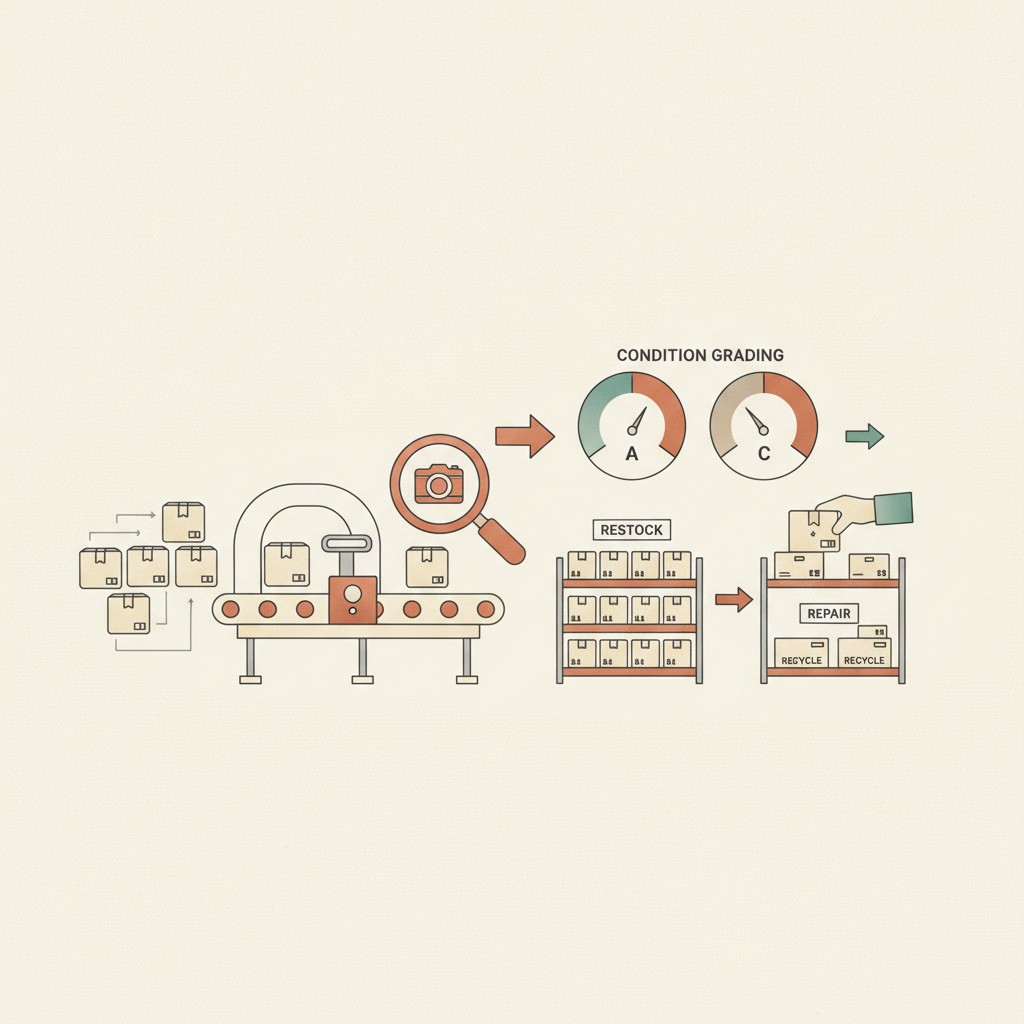
Grading model drift and retraining is the ongoing process of detecting when an AI condition-grading model's accuracy starts to slip as product mix, packaging, or lighting conditions change, then retraining it before that slip shows up in outcomes. At areturnz, this is treated as a standing operational discipline, not a one-time project: the AI grades every return on an A/B/C/R scale with a confidence score, operators log overrides on anything flagged for review, and that override data feeds a retraining loop built to hold the network's 99.6% AI-versus-operator match accuracy across 180K+ returns processed.
Why grading models drift in the first place
A grading model trained on last year's return mix is not guaranteed to perform the same way on next year's. Drift is not a bug, it is what happens when the world the model sees keeps changing while the model itself stays fixed. At a facility processing tens of thousands of returns a month out of NJ-01 in East Hanover, New Jersey, several forces push against grading stability at once.
New SKUs and new categories
A retailer that starts routing beauty returns through the network after a year of mostly apparel is handing the model a condition profile it has seen less of: cracked compacts, broken seals, different defect textures. Accuracy on the categories it knows well does not necessarily transfer. This is part of why grading apparel, electronics, and beauty is handled as three related but distinct problems rather than one generic model.
Seasonal mix shifts
Q4 and January returns skew toward gift items, unworn apparel with tags still attached, and electronics in original packaging. The defect patterns operators see in March look different. A model tuned on spring data can get quietly worse at reading holiday-season condition signals if nobody is watching for it.
Packaging and brand changes
Brands redesign boxes, change poly bag materials, swap tamper seals. Each change alters what a damaged parcel looks like in a photo. None of this is dramatic on its own, but it accumulates.
Camera and receiving hardware changes
Lighting, camera angle, or a new scanning station at receiving can shift image quality just enough to change what the model reads as a scuff versus a shadow. Hardware updates on the receiving line, like in-browser camera scanning, are evaluated for grading impact before they roll out broadly.
How areturnz detects drift before it hurts the match rate
Waiting for the 99.6% number to drop is the wrong way to find drift. By the time a headline metric moves, the damage is already in the disposition queue. Detection has to happen earlier, at the level of individual grading decisions.
Shadow scoring against operator overrides
Every grade the model assigns gets compared against the final disposition after any human override, the same mechanism covered in the confidence calibration process, except the lens here is time, not individual items. Operators tracking override rates by category, week over week, can spot a category where disagreement is creeping up well before it becomes a trend line anyone would call a problem on a dashboard.
Confidence score distribution monitoring
A healthy model produces a confidence score distribution that stays fairly stable: most grades land with high confidence, a smaller share get flagged for review, and that review rate holds roughly steady. When the flagged share for a category starts climbing without a corresponding change in actual item condition, that is an early drift signal worth investigating before it touches the match rate.
Review queue escalation patterns
Items that get routed to human review and then get overridden in a consistent direction, say, the model keeps grading something a B when operators keep calling it a C, point to a specific failure mode rather than random noise. This pattern recognition is what separates ordinary false-positive handling from drift detection: false positives are about individual misgrades, drift is about a model's error pattern shifting over weeks or months.
| Drift signal | What it looks like in practice | Typical response |
|---|---|---|
| Rising override rate in one category | Operators disagreeing with AI grade more often on, say, electronics returns specifically | Targeted retrain on that category's recent labeled data |
| Confidence score compression | More items landing in the mid-confidence band instead of clearly high or low | Review threshold adjustment plus data audit |
| Seasonal mix shift | Grade accuracy dips briefly at the start of Q4 or January as return composition changes | Pre-seasonal retrain using prior year's seasonal data as a baseline |
| Packaging or hardware change | A specific brand's returns start triggering more flags after a box redesign | Incremental retrain with new packaging samples added to the training set |
The retraining loop
Detection only matters if it leads to action. The retraining loop at areturnz runs on a mix of scheduled cadence and trigger-based response, because relying on either one alone leaves gaps.
Cadence and triggers
Scheduled retraining happens on a regular interval regardless of whether anything looks wrong, treating model refresh the way a factory treats routine maintenance. Trigger-based retraining happens when the monitoring described above crosses a threshold, an override rate climbing past a set point in a given category, for example. Between the two, a model should never go untouched for long enough that drift has time to compound.
The operator override log as training data
Every override an operator makes is logged with the original AI grade, the reasoning tag if one was captured, and the final disposition. That log is not just an audit trail, it is the raw material for retraining. A model that disagrees with operators 50 times in one category in a month has effectively been handed 50 labeled examples of exactly where it needs to improve, which is the same override infrastructure referenced in how disposition rules turn grades into decisions.
Validation before rollout
A retrained model does not go live network-wide on day one. It gets validated against a held-out set of recent, already-adjudicated returns first, and its predictions get compared against what operators actually decided. If the retrained model does not clear the existing match rate on that validation set, it does not ship. This is the same discipline that keeps autonomous disposition safe to expand: nothing gets more automated authority than its recent track record earns.

What holding 99.6% actually requires
The 99.6% AI-versus-operator match accuracy figure is not a one-time benchmark, it is a maintained number, recalculated continuously against the roughly 48 hour median cycle from inbound scan to disposition across the network's full volume. Holding that number as volume grows past 180K+ returns processed means the retraining loop has to scale with the business, not sit still while the business moves. A model that was accurate at 50,000 returns and never touched again will not necessarily be accurate at 500,000, because the categories, brands, and seasonal patterns running through the network keep expanding.
For brands and partners evaluating any AI grading claim, the real question is not just what the accuracy is today, it is how anyone can know it will still be true in six months. The evidence bundle attached to every return, viewable in the dashboard or pulled via the signed-JSON API, gives a concrete trail for anyone who wants to check that match rate against their own return history rather than take a published number on faith. You can see a sample of what that evidence actually looks like at the evidence sample page, and the broader grading system is covered in full in the AI and grading pillar guide.
Frequently asked questions
How often does areturnz retrain its grading model?
Retraining happens on a scheduled cadence and is also triggered early when monitoring detects a rising override rate or confidence score shift in a specific category, rather than waiting for a fixed calendar date regardless of signal.
Does model drift mean the 99.6% match accuracy number is misleading?
No, the number reflects the current, maintained state of the model against live operator decisions. Drift is the reason continuous monitoring and retraining exist, the figure is reported because it is actively defended, not because it was measured once and left alone.
What data is used to retrain the grading model?
Operator overrides are the core input: every case where a human adjudicator's final call differed from the AI's initial grade gets logged with the item's evidence photos and becomes labeled training data for the next retraining pass.
Can a retrained model make grading worse?
It can, which is why every retrained model is validated against a held-out set of recent adjudicated returns before it goes live network-wide. If it does not match or beat current performance on that validation set, it does not ship.
Does drift affect all categories equally?
No. Categories with fast-changing packaging, seasonal mix, or newly onboarded SKUs tend to drift faster than stable, high-volume categories. Monitoring is done per category rather than on one blended network-wide number so a problem in one area does not hide inside a strong overall average.
If you want to see how this grading and retraining discipline holds up against your own return volume and category mix, get in touch with the areturnz team.
Related reading: Open Box vs Refurbished vs Used: What the Condition Labels Actually Mean