False-positive handling: what happens when AI grading gets it wrong

False-positive handling in AI grading is the set of checks that catch a return graded better, or worse, than it actually is before that grade drives a disposition decision. At areturnz, every parcel is photographed at receiving, scored by the AI on an A/B/C/R condition scale with a confidence value, and any grade that falls below the confidence threshold or gets flagged by disposition rules is routed to a human operator for review, with the override logged against the original AI call.
This matters because grading is not a one-and-done event. It feeds a disposition: restock, liquidate, donate, or destroy. A false positive, meaning the AI says a returned item is cleaner or more complete than it really is, can send damaged stock back to shelf. A false negative sends resellable stock to liquidation at a fraction of its value. Both cost money. The real question is not whether a model ever gets it wrong. It is what happens in the next sixty seconds after it does.
Where false positives come from in AI grading
Most false positives in condition grading trace back to a small set of causes, worth naming plainly instead of hiding behind a vague accuracy number.
Lighting and angle gaps at receiving
A scuff photographed under harsh warehouse light can look worse than it is. A hairline crack photographed at the wrong angle can be missed entirely. areturnz's receiving stations capture the outer label, the opened parcel, the item itself, and any visible defect as four distinct images specifically to reduce this kind of blind spot.
Category-specific defect patterns
A grading model trained heavily on apparel returns can misread a scuffed phone screen, and vice versa. Confidence scores tend to run lower when an item's defect pattern does not match what the model has seen most often for that category.
Ambiguous claims about condition
Items that are functionally fine but missing an accessory, or that show wear inconsistent with the stated reason for return, sit in a gray zone. This is exactly where a B versus C grade decision can swing the wrong way without a second look.
The operator override loop
Grading confidence is the trigger. When the AI's confidence score on a grade falls under the set threshold, or when detected tags conflict with the stated return reason, the parcel is queued for a human operator instead of moving straight to disposition. The operator reviews the same photo set the AI used, confirms or corrects the grade, and that decision is logged as an override tied to the original AI output.
That override record is what makes the accuracy number credible. Across 180K+ returns processed, AI grades match operator judgment on about 99.6% of reviewed cases. The 0.4% gap is not swept aside. It is the exact population this workflow exists to catch, and every one of those cases becomes training signal for the next model update.
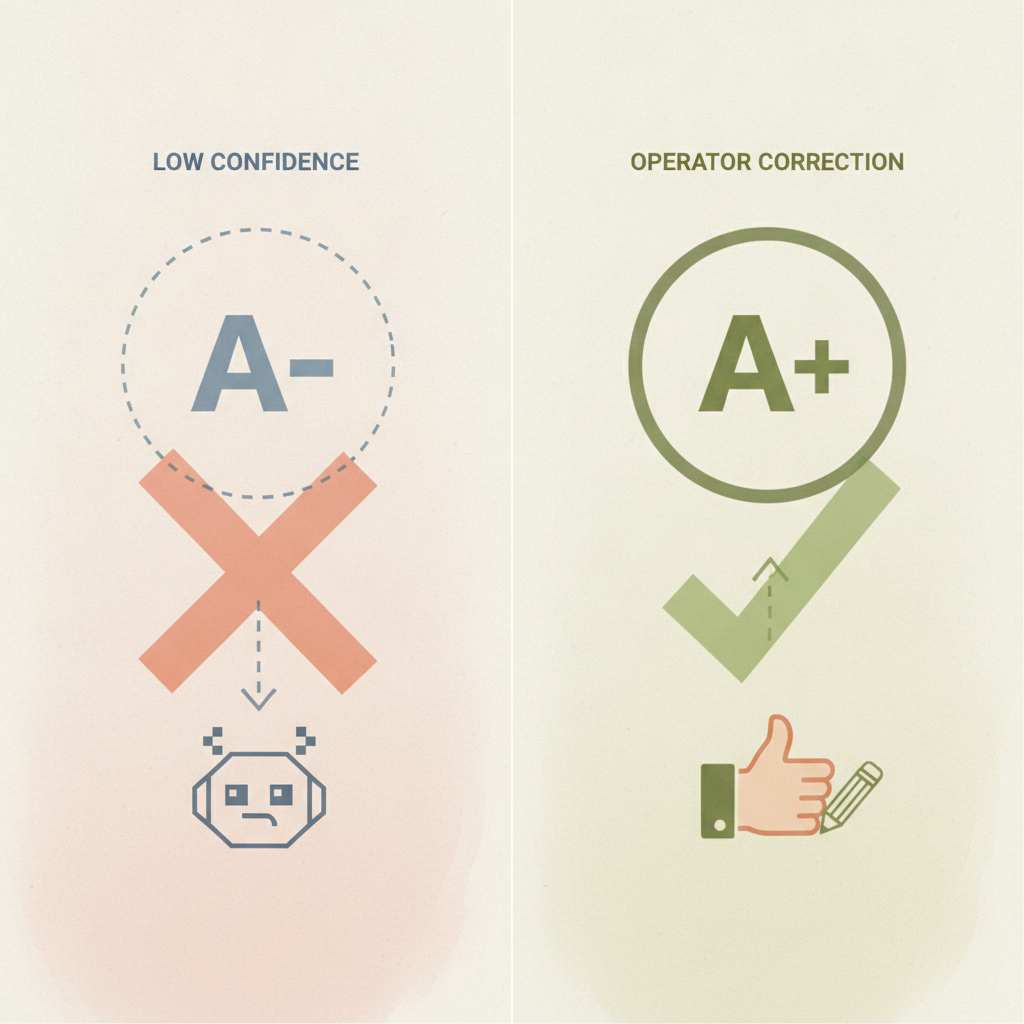
False positive vs. false negative: why the fix differs
Not every grading error costs the same amount, and the two error types call for different corrections in the workflow.
| Error type | What happens | Downstream risk | How the loop catches it |
|---|---|---|---|
| False positive | Damaged or incomplete item graded higher than warranted (for example, a C item scored B) | Restocked item disappoints next buyer, drives a fresh return or dispute | Confidence threshold flags low-certainty grades for operator review before restock |
| False negative | Resellable item graded lower than warranted (for example, a B item scored C or R) | Good inventory routed to liquidation, margin left on the table | Disposition rules cross-check grade against detected tags and return reason for mismatches |
| Ambiguous or low confidence | Model can't commit to a grade with high certainty | Delay if unresolved, wrong disposition if forced | Automatic routing to human operator, override logged either way |
How areturnz keeps the 99.6% match rate honest
A match rate is only useful if it is measured against real human review, not against the model's own confidence. Every override, whether the operator agrees or disagrees with the AI, gets logged with a timestamp and reason code. That log is what produces the 99.6% figure, and it also feeds the evidence bundle attached to each return. If a brand or platform partner ever questions a disposition, the photo set, the AI grade, the confidence score, and any operator note are all available in the dashboard or via the signed-JSON API, the same record referenced in our piece on how ABCR condition grading actually works.
The 48 hour median cycle from inbound scan to disposition holds even with this review step built in, because only the low-confidence and flagged cases route to a person. Most parcels clear on AI grade alone, which is what keeps the network fast without making speed the enemy of accuracy.
What this looks like on a real parcel
Say a returned jacket comes in tagged as wrong size, but the AI detects a stain in the opened-parcel photo with a confidence score under threshold. Instead of auto-routing to restock, the case queues for operator review. The operator checks the same photo, confirms the stain, downgrades the item from B to C, and disposition shifts from restock to liquidation. The override is logged, the evidence bundle now shows both the original AI grade and the corrected one, and the brand's dashboard reflects the final disposition with full traceability. That loop is covered in more depth in our note on how confidence scores beat gut calls on the grading line.
Frequently asked questions
What counts as a false positive in AI condition grading?
A false positive is when the AI assigns a grade (A, B, C, or R) that is better than the item's actual condition warrants, which can send a flawed item toward restock instead of liquidation or destruction.
How often does areturnz's AI grading disagree with human operators?
Across more than 180K returns processed, AI grades match operator judgment on about 99.6% of reviewed cases. The remaining fraction routes through override logging and feeds model improvement.
Does false-positive review slow down the return cycle?
Not meaningfully. Only low-confidence or flagged cases route to a human operator, so the median cycle from inbound scan to disposition stays around 48 hours.
Can a brand see when an operator overrode the AI grade?
Yes. Every override is logged and included in the evidence bundle for that return, viewable in the dashboard or pulled via the signed-JSON API. You can see a sample of what that looks like at our evidence sample page.
Where does false-positive handling fit into the disposition process?
It sits upstream of disposition rules. A grade has to clear confidence and consistency checks before it is allowed to trigger a restock, liquidate, donate, or destroy decision, as covered in our AI and grading pillar content.
Want to see how false-positive handling holds up on your own return volume? Talk to areturnz about running a sample batch through the network.
Related reading: Autonomous Disposition: When AI Grading Skips the Human Review Queue
Related reading: AI Condition Grading: The Complete Guide to ABCR at areturnz
Pruebas en cada devolución
Fotos, un grado de estado con IA y una cadena de custodia completa, adjuntos a cada paquete y disponibles vía la API.


