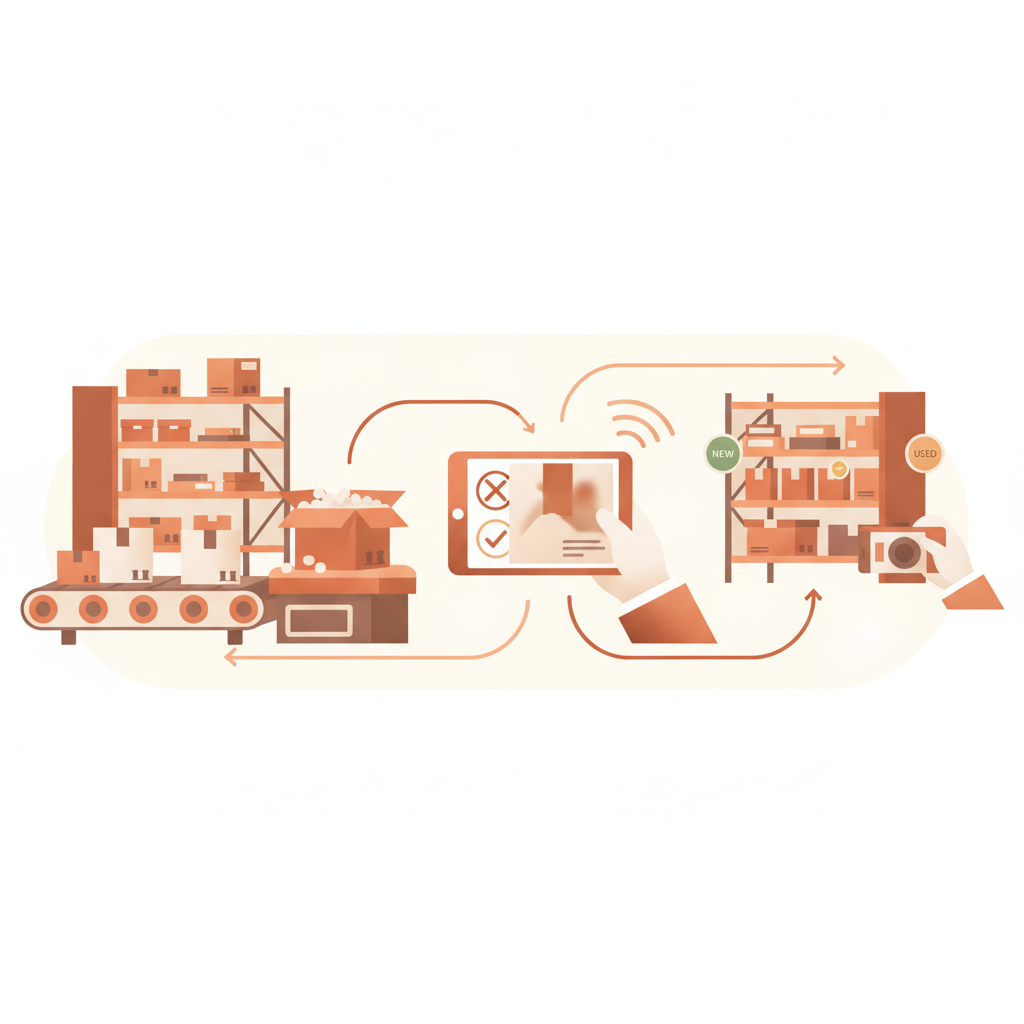
Returns management glossary: every returns term defined in one place
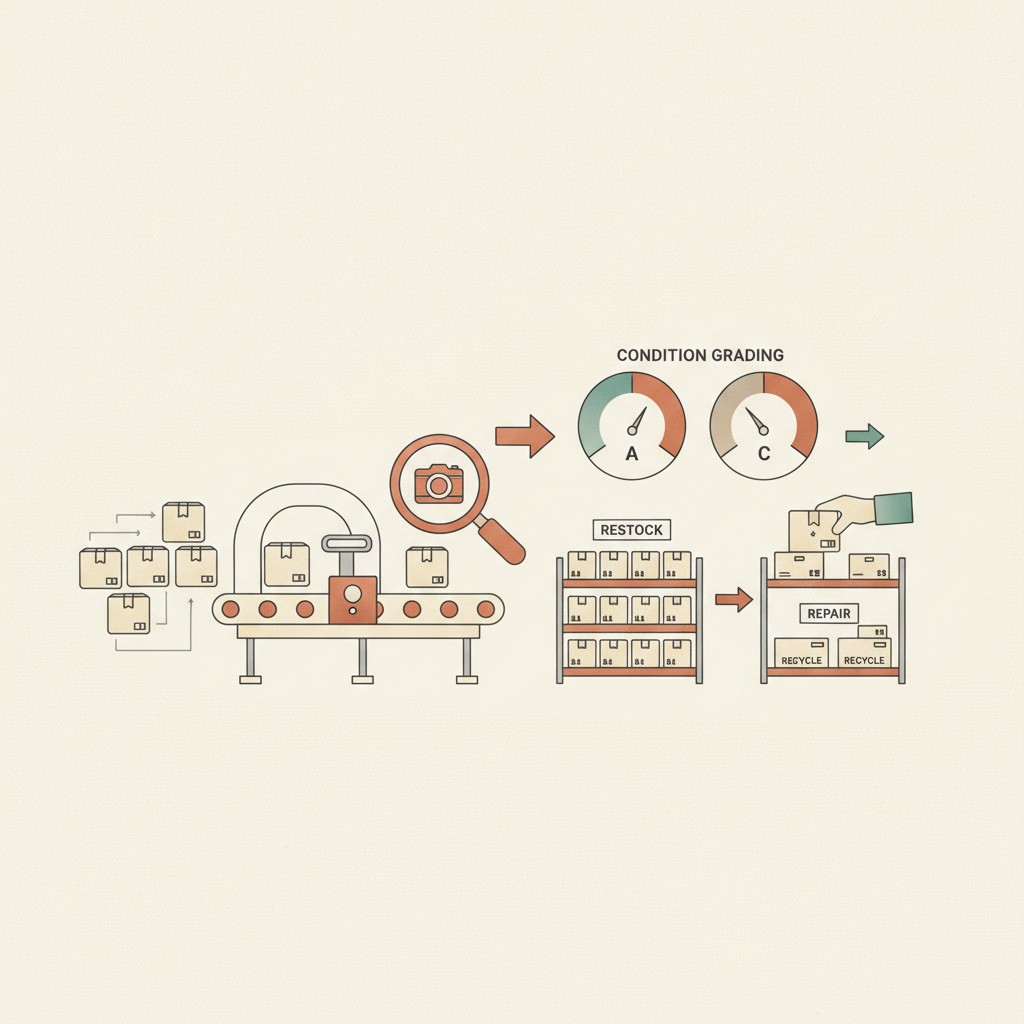
A returns management glossary is a single reference that defines the terms used across intake, grading, disposition, and dispute resolution for returned merchandise, so teams can talk about the same process the same way. areturnz built this one from the terms its own network uses daily across more than 180K+ processed returns, where every parcel is photographed, AI-graded on an A/B/C/R scale, and routed to a disposition with a logged, auditable trail.
Returns vocabulary gets muddy fast because retailers, 3PLs, marketplaces, and brands each use slightly different words for the same step. A "return merchandise authorization" at one company is just "an RMA" at another. "Grading" means a visual check at one warehouse and a camera-plus-model decision at another. This page sorts the terms into groups: process terms, AI and grading terms, evidence and trust terms, economics and KPI terms, and partner or platform terms, so you can scan to the one you need.
How to use this glossary
Each entry is short on purpose. Where a term has a deeper explainer already published, the entry links out to it. If you are building a returns program from scratch, start with the economics section, then move to grading, then evidence. If you already run a program and just need a shared vocabulary for a vendor conversation or an RFP, the quick-reference table below covers the terms that come up most often.
| Term | One-line definition | Why it matters |
|---|---|---|
| RMA (return merchandise authorization) | The approval and tracking number issued before a customer ships a return back | Without it, inbound parcels cannot be matched to an order or a reason code |
| Reverse logistics | The full chain of moving a product from the customer back into inventory, resale, or disposal | Returns processing is one stage inside reverse logistics, not the whole of it |
| Disposition | The decision applied to a graded return: restock, liquidate, donate, or destroy | Disposition accuracy drives recovery rate more than almost any other variable |
| ABCR grading | A four-tier condition scale (A/B/C/R) assigned by AI at receiving | Standardizes condition language across categories and facilities |
| Confidence score | A numeric estimate of how certain the grading model is about a given grade | Low-confidence grades route to human review instead of autonomous disposition |
| Chain of custody | The timestamped record of who handled a unit and when, from inbound scan to final disposition | Required to win item-not-as-described disputes and chargebacks |
| Evidence bundle | The photo set, grade, confidence score, and disposition log attached to one return | What gets handed to a buyer, a brand, or an auditor when a dispute opens |
| Restocking fee | A fee deducted from a refund to offset the cost of processing a return | Affects both customer experience and recovery math |
| Markdown decay | The ongoing loss of resale value the longer a returned item sits ungraded | Speed of disposition is a margin lever, not just an operations metric |
| Restock velocity | The time from inbound scan to the item being sellable again | A faster cycle recovers more margin per unit before markdown decay sets in |
Core returns processing terms
Returns processing
Returns processing is the physical and digital handling of a returned item after it leaves the customer: receiving, inspection, grading, and routing to its next destination. It sits inside the broader discipline of returns economics, which covers the cost and recovery side of the same flow.
Reverse logistics
Reverse logistics describes the end-to-end movement of goods backward through the supply chain, from the customer to a warehouse, reseller, liquidator, or landfill. Returns processing is the operational layer inside reverse logistics; a reverse logistics company can refer to anything from a label generator to a full processing network.
RMA (return merchandise authorization)
An RMA is the number or code a retailer issues before accepting a return, used to match the inbound parcel to the original order, the reason code, and the refund. Most returns portals generate RMAs automatically; the RMA itself says nothing about what condition the item arrives in.
Disposition
Disposition is the decision made about what happens to a returned unit once it has been graded: restock, liquidate, donate, or destroy. areturnz applies disposition rules automatically based on grade and confidence score, with every operator override logged for audit.
Restocking fee
A restocking fee is a charge deducted from a customer's refund, usually a flat amount or a percentage, meant to offset handling and inspection costs. Policy design here affects both conversion and recovered margin.
Cycle time
Cycle time is the elapsed interval from inbound scan to final disposition. areturnz runs a 48 hour median cycle across its network, which matters because every day a return sits ungraded, its resale value erodes.
AI and grading terms
ABCR grading scale
ABCR is a four-tier condition scale: A (like new, fully restockable), B (light wear, restockable with a note), C (visible damage or missing components, routed to liquidation), and R (unsellable, routed to destruction or donation). Each grade is assigned by AI from photos taken at receiving, with a confidence score attached. The full breakdown lives in the ABCR grading guide.
Confidence score
A confidence score is the model's own estimate of how sure it is about a grade. areturnz's grading model runs at about 99.6% AI-vs-operator match accuracy, and returns that fall below a confidence threshold get routed to a human reviewer instead of autonomous disposition.
Autonomous disposition
Autonomous disposition is when a high-confidence AI grade triggers a disposition decision without a human in the loop. Low-confidence grades skip this path and queue for manual review.
Open box, refurbished, used
These are resale condition labels, often confused with grading tiers. Open box usually means the packaging was opened but the item is unused. Refurbished means the item was repaired or restored to working order. Used means prior ownership with visible wear. The full comparison maps these labels against ABCR grades.
Evidence and trust terms
Evidence bundle
An evidence bundle is the complete record attached to a single return: the outer label photo, the opened parcel photo, the item photo, the defect photo if applicable, the AI grade, the confidence score, and the disposition log. Bundles are available in the dashboard and via a signed-JSON API with webhooks. You can see a live example at the evidence sample page.
Chain of custody
Chain of custody is the timestamped record of every handoff a returned unit goes through, from the inbound scan at the facility to its final disposition. It is the backbone of dispute resolution, covered in depth in why every return should ship with proof.
Item not as described (INAD)
INAD is a dispute type, usually on marketplaces, where a buyer claims a received item did not match its listing. Photo evidence and grading records close these disputes faster because they establish condition at the point of receiving, not after a buyer's claim.
Wardrobing
Wardrobing is a form of return fraud where a customer uses an item, often apparel, then returns it as if new. Evidence patterns across multiple returns from the same account can flag repeat wardrobing behavior.
Economics and KPI terms
Liquidation recovery rate
Liquidation recovery rate is the percentage of original retail value recovered when a graded item is sold through a secondary channel instead of restocked. Rates vary widely by category and grade.
Returns reserve accounting
Returns reserve accounting is the practice of budgeting for returns that have been sold but not yet received back, typically as a liability line against revenue already recognized.
Restock velocity
Restock velocity measures how quickly a graded item becomes sellable inventory again. Faster velocity directly offsets markdown decay, the gradual loss of resale value while an item sits ungraded or unlisted.
Partner and platform terms
White-label returns
A white-label returns setup lets a partner, such as a 3PL or platform, resell returns processing under its own brand while the underlying facility and grading infrastructure run on someone else's network. See how partners use areturnz for a working example.
Multi-tenant
Multi-tenant architecture means multiple brands or sellers share the same processing infrastructure while their data, webhooks, and reporting stay isolated from one another.
Webhook
A webhook is an automated, real-time notification sent to a partner's system when a return's status changes, such as moving from received to graded to dispositioned.
SLA (service level agreement)
An SLA is the documented commitment on turnaround time, accuracy, and reporting cadence between a returns network and the partner or brand it serves.
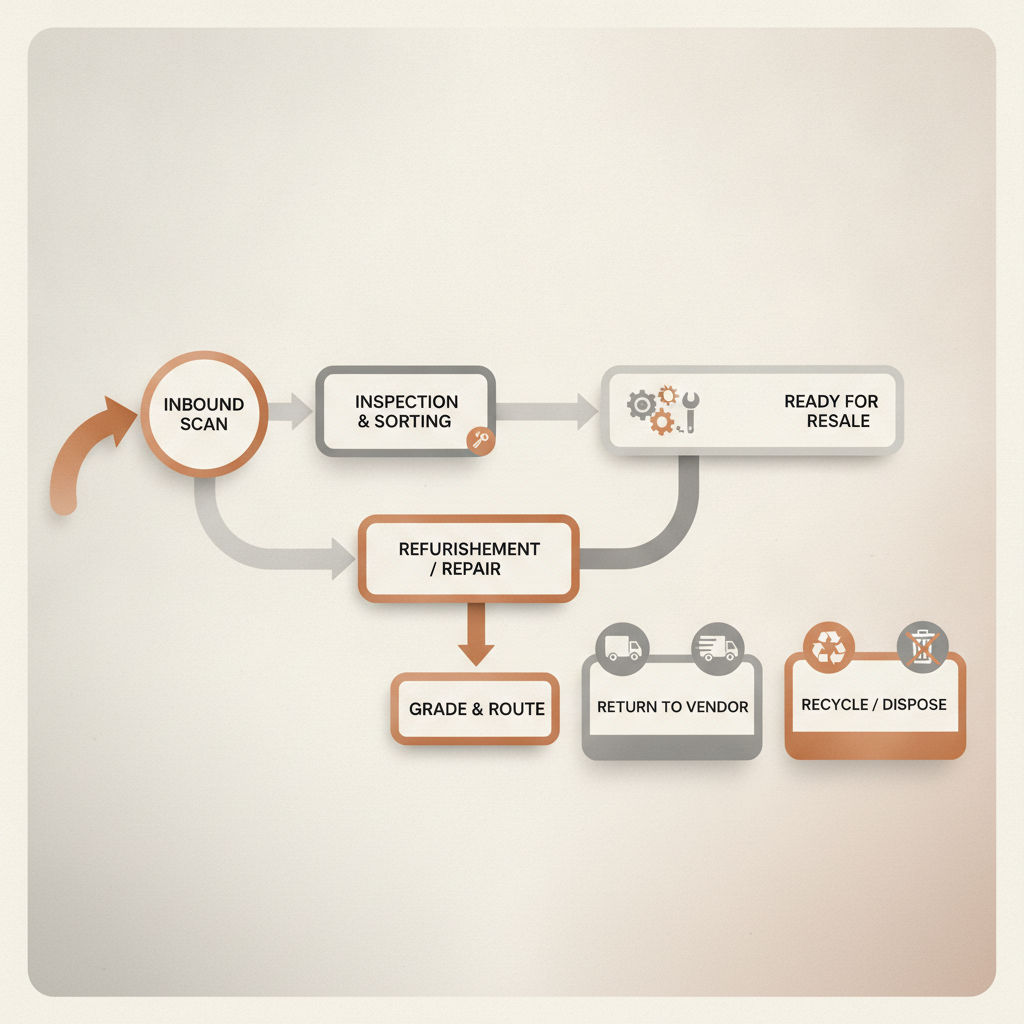
Condition label quick reference
| Label | Common meaning | Typical ABCR mapping |
|---|---|---|
| Open box | Packaging opened, item unused | A or B |
| Refurbished | Repaired or restored to working condition | B |
| Used | Shows wear from prior ownership | B or C |
| Damaged / salvage | Functional issues or missing parts | C or R |
For more on the economics underneath these decisions, including restocking fees, liquidation math, and reserve accounting, the returns economics pillar guide ties the full cost picture together. For pricing on running returns through a graded, evidence-backed network, see areturnz pricing.
Frequently asked questions
What is the difference between returns management and reverse logistics?
Returns management is the broader discipline of policy, cost, and process around handling returns, including returns management software and reporting. Reverse logistics is the physical movement of goods backward through the supply chain. Returns processing, the step areturnz operates, sits inside both.
What does the ABCR grade actually control?
Each grade feeds a disposition rule. A and most B grades route to restock, C typically routes to liquidation, and R routes to donation or destruction. Confidence score determines whether that routing happens automatically or goes to a human reviewer first.
Why does chain of custody matter for a glossary term and not just a legal one?
Because so many other terms depend on it. Evidence bundles, dispute resolution, chargeback defense, and even insurance claims all reference the same underlying chain of custody record.
Is a restocking fee the same as a return fee?
Not exactly. A restocking fee specifically offsets processing and inspection cost on an item that is returned. A return fee can refer more broadly to any charge tied to the return, including return shipping.
Where can I see what an evidence bundle actually looks like?
The evidence sample page shows a real bundle structure: photos, grade, confidence score, and disposition log, exactly as it appears in the dashboard and API.
If your team needs a shared vocabulary across ops, finance, and partners, or you want to see how these terms map to a live returns network processing 180K+ returns at a 48 hour median cycle, contact areturnz to talk through your setup.
Une preuve sur chaque retour
Des photos, un grade d'état par IA et une chaîne de traçabilité complète, rattachés à chaque colis et accessibles via l'API.