What Is a Restocking Fee? How It Works and Why Retailers Charge It

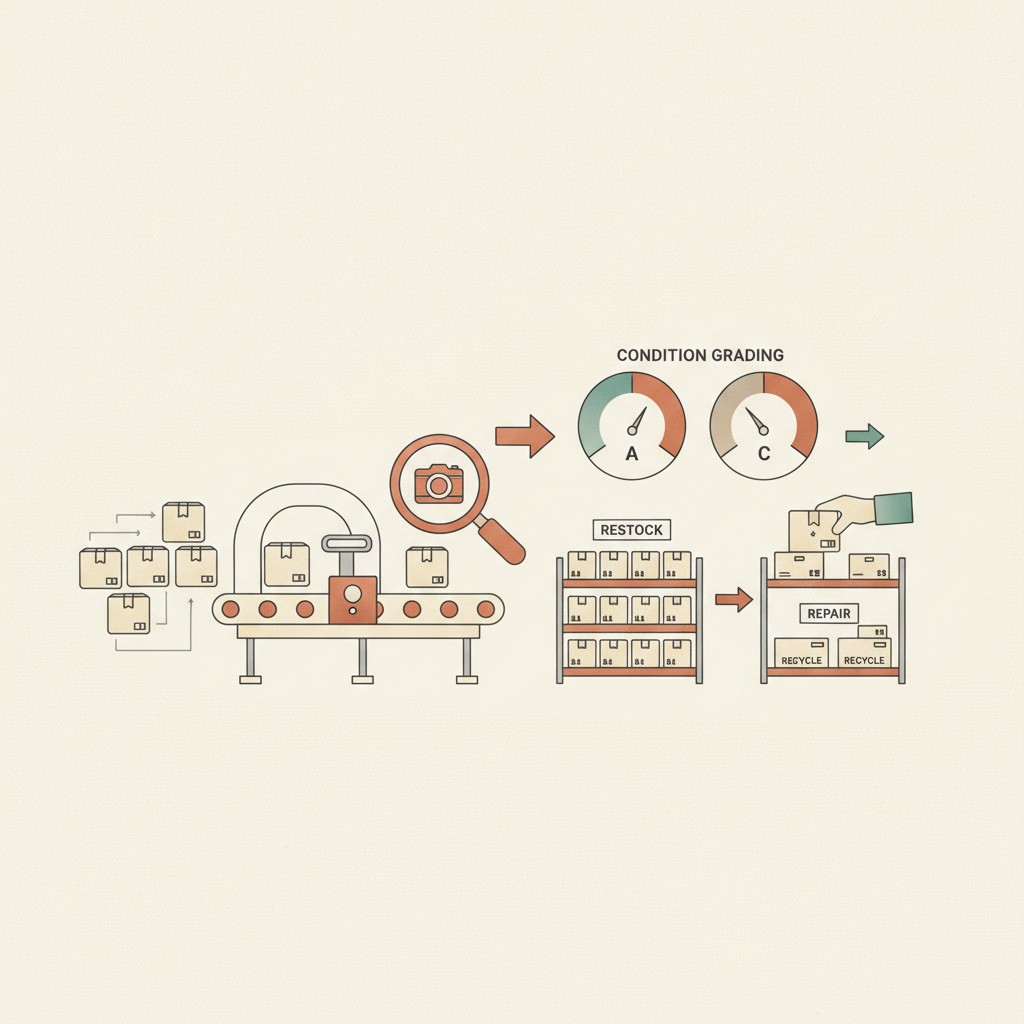
A restocking fee is a percentage of the purchase price that a retailer subtracts from a customer's refund when an item is returned, usually to offset the labor, inspection, repackaging, and markdown cost of getting that item back into sellable condition. areturnz processes the physical side of that equation: every returned parcel gets photographed, AI-graded on an A/B/C/R scale, and routed to restock, liquidate, donate, or destroy, which gives a retailer the real cost data needed to set a restocking fee that actually matches what the return cost them.
Restocking fees range from 10% to 50% of an item's price depending on category, condition, and how the return happened. Some retailers charge nothing at all. The fee exists because processing a return is never free, even when the item comes back in like-new condition, and the gap between what a refund costs a retailer and what the customer actually sees is where restocking fees live.
How a restocking fee actually works
When a customer initiates a return, the retailer's policy determines whether a fee applies before the item even ships back. Common triggers include missing original packaging, items returned without tags, electronics opened and used, furniture or appliances requiring freight pickup, and returns made outside a standard window but still inside a grace period. The fee is deducted at the point of refund, so a customer who paid $200 for a jacket and faces a 15% restocking fee gets $170 back, not $200.
The percentage itself is rarely arbitrary, or at least it shouldn't be. It's meant to approximate the real cost of reverse logistics: inbound freight, receiving labor, condition grading, repackaging materials, and the markdown a retailer takes if the item can't go back on a primary shelf at full price. Our article on the real cost of a return breaks down how those line items stack up, and the restocking fee is essentially a retailer's attempt to pass a slice of that cost back to the customer rather than absorb it entirely into margin.
Why retailers charge restocking fees
Three forces usually drive the decision. First, category risk: electronics, furniture, and mattresses carry high per-unit processing and resale friction, so fees run higher in those categories. Second, return behavior: retailers fighting wardrobing or serial returning use fees as a deterrent, charging on worn or used items specifically. Third, margin protection: a retailer processing high return volume on thin-margin goods needs some mechanism to keep returns from eating the entire category's profit, and a restocking fee is the most direct lever available without changing the sticker price.
Not every retailer charges one. Many DTC brands advertise free returns as a conversion tool, accepting the processing cost as a cost of doing business. That tradeoff is covered in depth in our piece on free returns vs paid returns, which looks at how the decision affects both conversion rate and net margin per order.
Typical restocking fee ranges by category
| Category | Typical restocking fee | Common trigger |
|---|---|---|
| Apparel and footwear | 0% to 15% | Missing tags, worn condition, out-of-window return |
| Consumer electronics | 10% to 25% | Opened packaging, missing accessories, used condition |
| Furniture and large appliances | 15% to 50% | Freight pickup required, assembled or installed item |
| Beauty and personal care | Often non-returnable or 0% | Hygiene policy, opened seal |
| Sporting goods and outdoor gear | 10% to 20% | Used condition, missing original packaging |
Restocking fees versus the cost of the return itself
A restocking fee only covers part of the cost picture. The real number a retailer should be watching is what it actually costs to receive, grade, and redisperse that unit, which includes labor, shipping, and the markdown taken if the item lands in a B or C grade instead of going back to primary shelf as new. areturnz's grading pipeline assigns each return an A, B, C, or R grade with a confidence score at receiving, and that grade (not a flat policy percentage) is what determines whether an item is worth restocking at full price, discounting, or routing to liquidation. Our restock velocity article covers how fast that grade-to-shelf cycle needs to move before markdown decay erases any margin a restocking fee recovered.
This is where a flat restocking fee policy can misfire. A 15% fee charged uniformly across all returns assumes every return costs the same to process, but a lightly worn A-grade item and a damaged C-grade item have very different reprocessing costs. Retailers working with graded, evidence-backed return data can set fees (or waive them) based on actual condition rather than a blanket rule, which tends to produce fewer disputes and better customer sentiment without giving up margin recovery.

Restocking fees and customer disputes
Restocking fees are a frequent source of chargebacks and complaints, mostly because customers can't see why a fee was applied or how much was deducted until after the fact. A return that arrives with photo documentation, a recorded condition grade, and a timestamped evidence trail gives both the retailer and the customer a clear basis for the fee, rather than a judgment call made by whoever happened to open the box. That evidence also matters if a customer disputes the deduction with their card issuer, since a documented condition grade is harder to challenge than a verbal explanation. See a sample evidence bundle for what that documentation actually looks like in practice.
Setting a defensible restocking fee policy
A workable policy usually ties the fee to a specific, observable condition instead of a flat percentage on every return. That means defining what counts as resellable-as-new versus open-box versus damaged, and applying the fee only when the item fails to meet the top condition tier. Pairing that policy with consistent grading, at the kind of 99.6% AI-vs-operator match accuracy areturnz runs across more than 180K processed returns, keeps the fee defensible instead of arbitrary. A median 48 hour cycle from inbound scan to disposition also means the retailer knows the item's real condition and resale path before the refund is even finalized, rather than guessing at a fee percentage up front.
Frequently asked questions
Is a restocking fee legal?
In most of the United States, yes, as long as the fee is disclosed in the retailer's return policy before the purchase is made. A handful of states restrict or require specific disclosure language for restocking fees, so retailers typically post the percentage and the conditions that trigger it directly on the product or returns policy page.
Do all retailers charge a restocking fee?
No. Many retailers, particularly DTC apparel and beauty brands, advertise free returns to reduce purchase friction and absorb the processing cost into overall margin. Others, especially in electronics, furniture, and freight-heavy categories, charge a fee because the processing and resale cost per unit is significantly higher.
How is a restocking fee different from a return shipping fee?
A return shipping fee covers the cost of getting the item back to the retailer. A restocking fee covers what happens after it arrives: inspection, grading, repackaging, and any markdown taken before the item can be resold. A retailer can charge one, both, or neither depending on policy.
Can a restocking fee be waived?
Yes, most policies allow waivers for defective items, retailer error, or items returned in original, unopened condition within the stated window. Grading data that confirms an item's actual condition at receiving makes it easier to apply waivers consistently rather than case by case.
Does areturnz set restocking fee policy for retailers?
No. areturnz processes the physical return, grades condition, and provides the evidence and disposition data retailers use to set or refine their own restocking fee policy. The grading and evidence bundle give a retailer the real cost basis for the decision rather than making the policy call itself. Read the full returns economics guide for the broader cost picture behind that decision.
Want to see what graded, evidence-backed return data looks like before you set your next restocking fee policy? Contact areturnz to talk through your returns volume and current cost structure.
Related reading: What Is an RMA? Return Merchandise Authorization Explained
Related reading: Returns management glossary: every returns term defined in one place
Une preuve sur chaque retour
Des photos, un grade d'état par IA et une chaîne de traçabilité complète, rattachés à chaque colis et accessibles via l'API.