Chain of custody audit trails: proving where every returned unit went
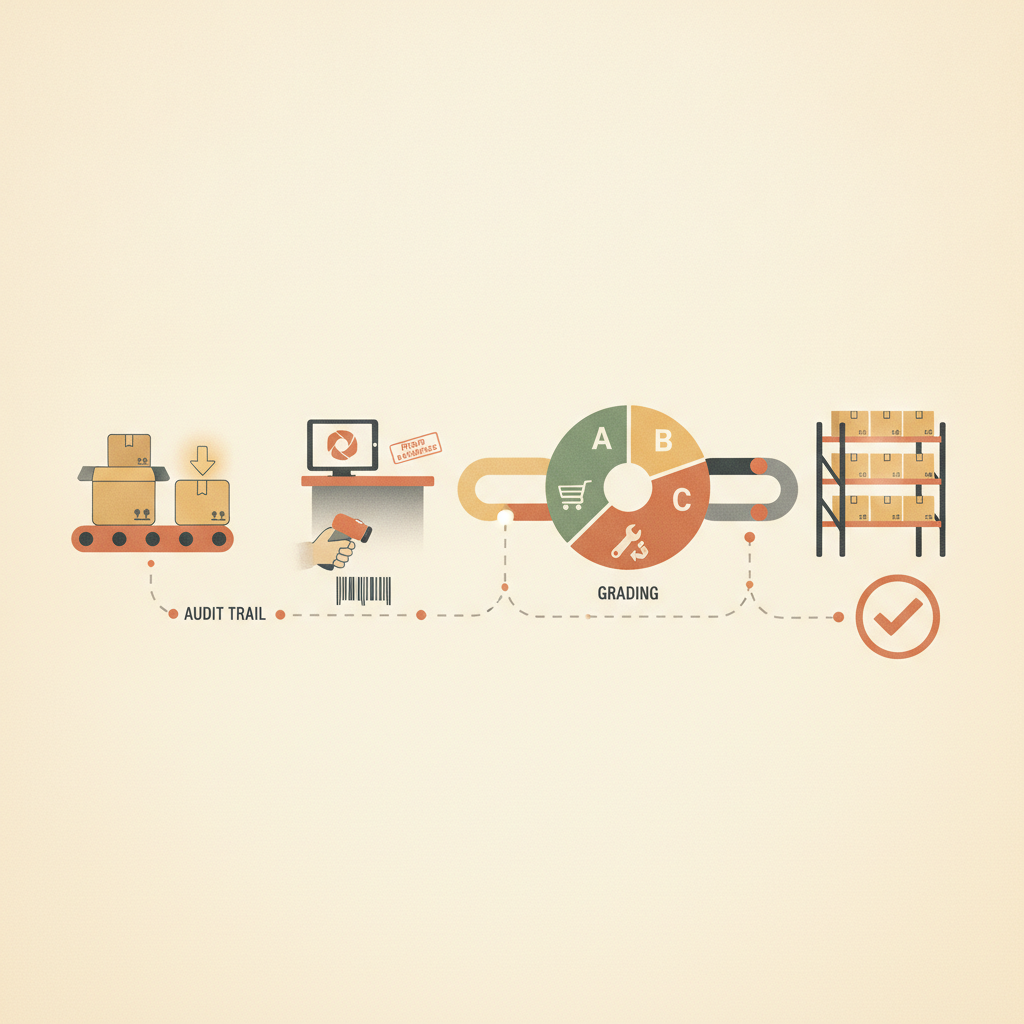
A chain of custody audit trail for returns is the timestamped record of every person, scan, photo, and decision that touched a unit from the moment it arrives to the moment it is restocked, liquidated, donated, or destroyed. areturnz builds this trail automatically on every parcel it processes, which means a retailer, brand, or partner can answer where a unit went and who decided that for any return, on demand, without digging through spreadsheets or emailing a warehouse manager.
Why custody gaps cost more than they look like they should
Most returns operations can tell you a unit's current status. Fewer can tell you its full history: who opened the box, what the item looked like on day one, which grade it received, who approved the disposition, and what happened to it after. That gap is invisible until someone needs it, and then it becomes expensive fast.
A chargeback dispute lands and the seller has 10 days to respond with proof the item came back damaged, not the retailer's fault. A brand's compliance team asks for evidence that 40,000 units were actually destroyed, not diverted to a gray market reseller. A marketplace partner accuses a returns processor of swapping a returned item for a lesser one before it went back on shelf. In every case, the question is the same: prove custody, or eat the loss.
What a real audit trail actually contains
A chain of custody record is not a single log line that says received. It is a sequence of discrete, evidenced events, each with its own timestamp, actor, and artifact. At areturnz, that sequence typically looks like this:
Inbound scan and photo capture
Every parcel gets scanned against its outer label the moment it hits the dock. The system captures the label photo, then a photo of the opened parcel, then the item itself, then any defect or damage in close-up. This happens before a human makes a single judgment call, which matters: the record exists independent of whoever grades it later.
AI grading with confidence score
The item is graded A, B, C, or R (resale-ready, light wear, heavy wear, or return-to-vendor / scrap) with a confidence score attached. That score, and the tags the model detected (stain, missing accessory, box damage, and so on), become part of the permanent record for that unit, not just an internal note.
Operator review and override logging
Any time a human operator disagrees with the AI grade, that override is logged with a reason code and the operator's ID. Nothing is silently changed. Across the network, AI and operator grades match about 99.6% of the time, so overrides are the exception, but they are always visible in the trail when they happen.
Disposition and routing
The grade feeds a disposition rule that routes the unit to restock, liquidation, donation, or destruction. The rule that fired, and any manual override of that rule, gets recorded alongside the grade that triggered it.
Exit event
Whatever happens next, whether the unit ships back out for resale, gets palletized for a liquidation buyer, or is destroyed with a certificate issued, that final event closes the loop and completes the chain.
For a deeper look at how the routing step works, see our post on disposition rules that turn grades into decisions, and for what happens at the destruction end of the chain, read about destruction certificates and duty drawback.
What separates a real audit trail from a status log
| Capability | Basic status tracking | Chain of custody audit trail (areturnz) |
|---|---|---|
| Timestamped events per unit | Usually one or two (received, closed) | Every touchpoint from inbound scan to exit event |
| Photo evidence | Rare or manual | Label, opened parcel, item, and defect photos on every parcel |
| Grade with confidence score | Not typically captured | A/B/C/R grade plus AI confidence score and detected tags |
| Operator override visibility | Often invisible or undocumented | Every override logged with reason code and operator ID |
| Access method | Internal system only, if it exists | Dashboard view and signed-JSON API with webhooks |
| Typical time to produce a full trail on request | Days, if possible at all | Minutes, pulled from the existing evidence bundle |
How the trail gets used after the fact
The audit trail is not built for its own sake. It gets pulled in three recurring situations.
Chargeback and dispute response
When a buyer or seller disputes the condition or disposition of a return, the full custody record, not just a photo, but the sequence of who touched it and when, is what closes the case quickly instead of dragging into a multi-week back-and-forth.
Compliance and destruction verification
Regulated categories (electronics with data-bearing components, certain cosmetics, recalled goods) often require proof that a unit was actually destroyed, not resold under a different label. The custody trail supplies that proof alongside the destruction certificate itself.
Partner and brand audits
Brands that let a partner or 3PL process their returns want assurance nothing is being diverted or misgraded before it reaches the brand's own resale channel. A custody trail with 180K+ returns processed across the network gives brands a pattern to check new partners against, not just a promise.
Where the trail lives and how fast it moves
Every unit that comes through NJ-01, our East Hanover, New Jersey facility, moves from inbound scan to disposition in a median of about 48 hours. The custody record builds in step with that cycle, not after it. That means the evidence bundle for a unit is usually complete and queryable well before anyone needs to dispute or audit it, rather than being reconstructed from memory weeks later.
The full bundle, photos, grade, confidence score, disposition, and any override, is visible in the dashboard and available programmatically through a signed-JSON API with webhooks, so a retailer's own systems or a partner's tenant dashboard can pull the record without a support ticket. You can see what an actual bundle looks like on our evidence sample page. For the broader case on why evidence needs to exist on every return, not just disputed ones, see our pillar guide, Returns Evidence and Dispute Proof: The Complete Guide.
Frequently asked questions
What is a chain of custody audit trail in returns processing?
It is the complete, timestamped record of every event a returned unit goes through: inbound scan, photo capture, AI grading with a confidence score, any operator override, the disposition decision, and the final exit event (restock, liquidation, donation, or destruction). It proves who touched the unit, when, and why a decision was made.
How is this different from a disposition rule?
A disposition rule is the logic that decides what happens to a unit based on its grade. The custody trail is the evidence record that shows the rule fired, what grade triggered it, and whether a human overrode it. One is decision logic, the other is proof the decision happened as recorded.
Can a custody audit trail help with a chargeback dispute?
Yes. A dispute typically hinges on the condition and handling of a returned item. A full custody trail with photos and a graded, timestamped sequence gives a seller documentation to respond to a chargeback quickly instead of relying on memory or incomplete notes.
How accurate is the grading data inside the trail?
Across the areturnz network, AI grades match operator judgment about 99.6% of the time. Every override is logged with a reason, so the small percentage of disagreements is visible rather than hidden inside the record.
Can partners and brands access the audit trail directly?
Yes. The evidence bundle behind each unit's custody trail is available in the dashboard and through a signed-JSON API with webhooks, so partners can pull records into their own systems. See our partner use cases or check pricing for how this fits into a resold returns program.
If you need to see exactly what a custody-backed evidence bundle looks like for your own return volume, contact areturnz and we will walk through a sample trail end to end.
Related reading: Marketplace Seller Return Fraud: Closing the INAD Loophole With Evidence


