Marketplace Seller Return Fraud: Closing the INAD Loophole With Evidence

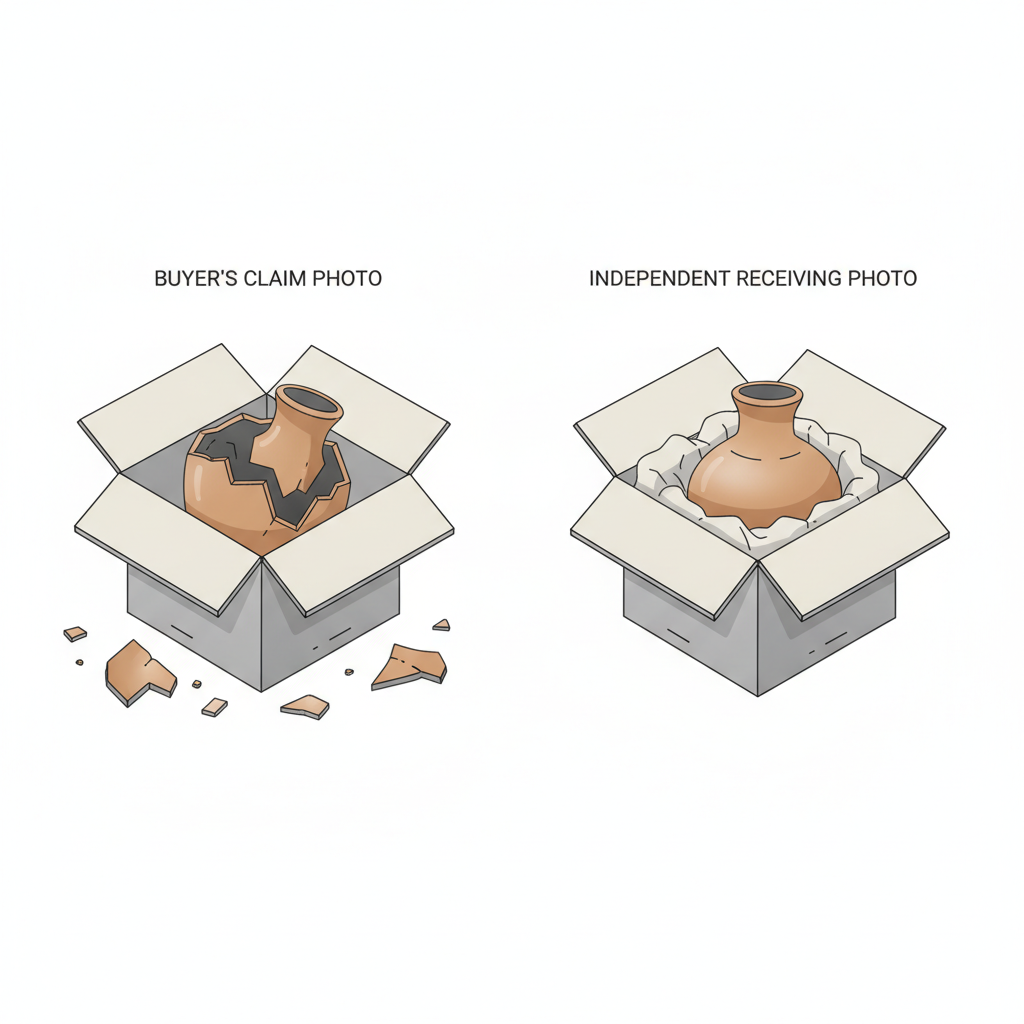
Marketplace seller return fraud built around item-not-as-described (INAD) claims is closed by attaching independent, timestamped evidence to every returned parcel so a buyer's claim can be checked against what the item actually looked like at receiving, not against a photo the seller submitted after the fact. areturnz does this on every unit it processes: an outer label photo, an opened-parcel photo, an item photo, and a defect photo if one exists, paired with an AI condition grade and a confidence score, all bundled into a signed record a marketplace or seller can pull in seconds.
INAD is supposed to protect buyers from sellers who ship damaged or wrong items. In practice it has become one of the cheapest fraud vectors on any marketplace. A buyer claims the item arrived broken, used, or not matching the listing, the platform sides with the buyer by default because sellers rarely have proof otherwise, and the seller eats a refund plus the item, sometimes without ever getting it back. Multiply that across a return-heavy category and the loophole becomes a line item large enough to show up in quarterly numbers.
Why INAD is the easiest fraud lever on a marketplace
Most marketplace return flows were designed around convenience, not evidence. A buyer opens a claim, uploads a phone photo if the platform even requires one, and a support agent makes a judgment call within a policy window measured in days. Sellers rarely see the returned item until it is already back on a shelf or written off. That gap between claim and inspection is where fraud lives: wardrobing, item swaps, empty-box claims, and outright false damage reports all exploit the fact that nobody with an incentive to check is actually looking at the parcel when it arrives.
The fix is not stricter policy language. It is having an independent party photograph and grade the item the moment it lands, before anyone with a stake in the outcome touches it. That is the role a dedicated returns processing network plays, and it is different from what a returns portal or a label generator does. Portals route a claim. They do not look inside the box.
What an evidence bundle actually contains
Every parcel processed through areturnz generates the same evidence set regardless of category or seller. That consistency matters for marketplace disputes because both sides need to trust the same record.
- Outer label photo, confirming the parcel matched the return authorization
- Opened-parcel photo, showing contents as received before any handling
- Item photo, isolating the product itself
- Defect photo, when the AI grading model or an operator flags visible damage
- An A/B/C/R condition grade with a confidence score
- A disposition decision (restock, liquidate, donate, destroy) with any operator override logged
That bundle is available in the areturnz dashboard and through a signed-JSON API with webhooks, so a marketplace or seller can pull the record automatically the moment a dispute opens rather than waiting on a manual request. You can see what one of these bundles looks like on the evidence sample page.
How the evidence closes specific fraud patterns
Different INAD fraud patterns get closed by different pieces of the same evidence set. The table below maps common claims to the proof that resolves them.
| Claimed issue | Fraud pattern | Evidence that resolves it |
|---|---|---|
| "Item arrived damaged" | Buyer damages item after delivery, then returns it as defective | Item and defect photos at receiving show actual condition on arrival, timestamped against carrier delivery scan |
| "Wrong item received" | Buyer swaps in a different, often cheaper, item before shipping the return | Opened-parcel and item photos confirm what was actually inside, compared against the original SKU |
| "Item was used or worn" | Wardrobing: buyer uses the item once, returns it as new | AI condition grade (A/B/C/R) with confidence score flags wear inconsistent with a new-item claim |
| "Box was empty" | Buyer claims non-receipt or empty parcel to get a refund plus keep the item | Opened-parcel photo and weight/scan data at inbound establish contents were present |
| "Not as described" | Buyer disputes condition to force a refund on a correctly listed item | Full evidence bundle plus disposition rule and grade give a documented, third-party assessment |
Because the same rules and camera stations apply across all 180K+ returns areturnz has processed, sellers are not relying on their own word against a buyer's. They are relying on a record generated by a neutral party at the moment of receiving, with a 48 hour median cycle from inbound scan to disposition and a 99.6% match rate between AI grading and operator review.
Where this fits for marketplace operators
Marketplaces sit in an awkward spot on INAD disputes. Side with the buyer every time and sellers churn or pad prices to cover losses. Side with the seller every time and buyer trust erodes. Evidence lets a marketplace resolve the dispute on facts instead of picking a side by policy default. That is a core reason marketplaces route returns through areturnz's network rather than building inspection into their own ops: the evidence has to be independent to be credible to both parties, which is exactly the case made in more detail on the marketplaces use case page.
Disposition rules keep the resolution consistent
Grading alone is not enough; what happens next has to be consistent too. areturnz applies disposition rules that route each graded return to restock, liquidation, donation, or destruction, with every operator override logged against the original AI grade. That log is part of the same evidence trail, so if a seller or marketplace later asks why an item was liquidated instead of restocked, the answer is documented rather than reconstructed from memory. The mechanics of that process are covered in more depth in disposition rules: turning grades into decisions.
What this looks like in a real dispute
Say a buyer opens an INAD claim alleging a returned jacket arrived with a torn lining. Without independent evidence, the seller has two options: refund and absorb the loss, or fight the claim with nothing but a listing photo from weeks earlier. With an areturnz evidence bundle attached to that same return, the seller (or the marketplace's dispute team) can pull the item photo and defect photo from receiving, see the AI grade and confidence score assigned at that moment, and check the timestamp against the delivery scan. If the lining was intact at receiving and the grade came back A or B with high confidence, the claim does not hold. If the tear was already flagged at receiving, the claim is legitimate and gets resolved without a fight. Either way, the decision takes minutes instead of a drawn-out back-and-forth, which is the same principle behind the broader approach laid out in killing the item not as described dispute.
Frequently asked questions
What counts as an INAD claim on a marketplace?
An item-not-as-described claim is any buyer dispute alleging the received product does not match the listing: wrong condition, wrong item, missing parts, or damage. Marketplaces typically require a refund or return once a claim is opened, which is exactly the mechanism return fraud exploits.
How is this different from a returns portal's dispute tools?
A returns portal manages the request: labels, status updates, refund triggers. It does not physically inspect the item. areturnz photographs, grades, and logs the disposition of the actual returned unit, which is the evidence a portal cannot generate on its own.
Can sellers dispute an AI grade if they think it's wrong?
Yes. Every AI grade carries a confidence score, and operators can override a grade, with that override logged as part of the evidence record. The AI-vs-operator match rate runs about 99.6%, so overrides are the exception, not the norm, but they are always documented rather than silently applied.
Does this slow down legitimate returns for honest buyers?
No. The evidence capture happens during normal receiving, inside the same 48 hour median cycle from inbound scan to disposition. Honest returns move through at the same speed; the difference only shows up when a dispute actually gets opened and someone needs proof.
Is this only useful for large marketplaces?
No. Individual brands and sellers who ship through a marketplace but process returns through areturnz get the same evidence bundle, which they can use directly in a marketplace's own dispute process rather than waiting on the platform to build inspection tooling.
To see how a full evidence bundle would apply to your marketplace's return volume, read the Evidence and Trust guide or talk to areturnz about routing your INAD-prone SKUs through the network.


