Choosing a returns node location: facility footprint and regional coverage economics

Returns node location economics is the set of cost and speed tradeoffs created by where a returns processing facility physically sits relative to the customers generating the returns. At areturnz, this is not theoretical: our NJ-01 facility in East Hanover, New Jersey anchors the Northeast corridor and carries a 48 hour median cycle from inbound scan to disposition across 180K+ returns processed, and that number moves depending on how far the parcel had to travel to reach the dock.
Most conversations about returns infrastructure start with price per unit. That is the wrong starting point. Price per unit hides the freight lane, the dwell time, the local labor market, and the regional demand pattern that actually determine whether a facility makes money or just moves inventory slowly in a different direction. If you are a brand, retailer, platform, or 3PL deciding where returns should land, or a partner evaluating whether to stand up a node, the location decision changes your unit economics more than almost any other variable you control.
Why facility footprint changes the math
A returns facility is not a warehouse that happens to receive mail. It is a node in a time-sensitive chain where every extra day of transit is a day of markdown decay, a day of carrying cost, and a day closer to a liquidation price instead of a restock price. Location affects three things at once: inbound transit time, outbound restock reach, and local operating cost.
Inbound transit time
The clock on a return starts when the customer drops the parcel, not when it reaches the facility. A node sitting near major population centers and carrier hubs shortens the gap between drop-off and receiving scan. Shave two days off inbound transit and you have effectively bought back two days of shelf life for a restockable item, without changing anything about grading speed or disposition logic.
Outbound restock reach
Grading an item A or B only pays off if it can get back into sellable inventory fast. A facility positioned near regional distribution centers or close to the original selling channel's fulfillment network shortens the outbound leg too. A node that is cheap to run but far from everything just relocates the delay instead of removing it.
Local operating cost
Labor rates, real estate, and utility costs vary by region, and they show up directly in cost per unit processed. A facility in a lower cost market can process returns more cheaply per unit, but only if the freight savings from proximity do not get eaten by the extra transit time. The honest exercise is modeling cost per unit AND days to disposition together, not either one alone.
The regional coverage tradeoff
Every network has to decide between concentration and spread. One large facility is cheaper to run and easier to standardize, but it creates longer average transit for customers far from it. Several smaller nodes shorten transit for more customers but add coordination overhead, duplicate equipment, and inconsistent grading unless the AI and process layer is identical everywhere.
| Footprint model | Typical inbound transit | Operating cost pattern | Grading consistency | Best fit |
|---|---|---|---|---|
| Single hub facility | Longer for distant regions | Lower per-unit cost, higher freight cost | High (one process, one team) | Lower SKU velocity categories, centralized brands |
| Two to three regional nodes | Moderate, tighter clustering | Balanced freight vs facility cost | High if standardized on shared AI grading | National retailers, multi-region marketplaces |
| Dense local network | Shortest, near-customer | Higher facility overhead, lowest freight | Requires strict standardization | High-velocity apparel, peak season absorption |
| Partner-run nodes (white-label) | Variable by partner footprint | Set by partner's existing real estate | Depends on shared grading standard | 3PLs and platforms extending reach without new builds |
None of these models is universally right. A brand selling mostly online nationally may do fine with two regional nodes if restock velocity stays acceptable. A marketplace with dense urban sellers might need tighter local coverage to protect resale timelines. The decision should follow the actual shape of your return volume, not a generic best practice.
What NJ-01 tells us about a working node
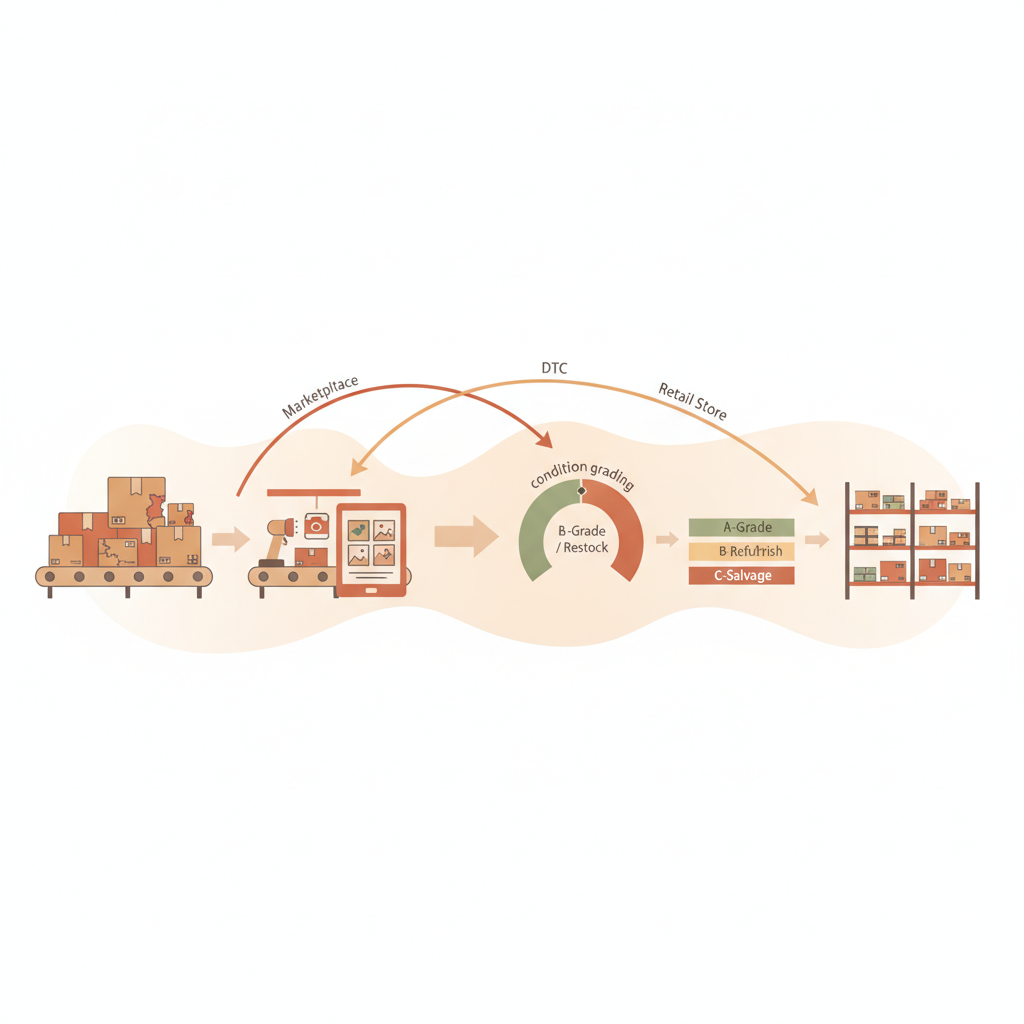
NJ-01 in East Hanover is useful as a reference point because the numbers are public and consistent. Across the volume it processes, the facility holds a 48 hour median cycle and a 99.6% AI-vs-operator match accuracy on grading, with every item still photographed at receiving, opened parcel, and defect stage regardless of where it originated. The location was chosen for its reach into the Northeast corridor: dense population, strong carrier infrastructure, and proximity to major distribution lanes that let graded inventory move back into restock channels quickly instead of sitting in a queue.
The lesson is not that every node should look like NJ-01. It is that a node's value is measured by how its location shortens the full loop, inbound and outbound, not by its square footage or headline processing capacity.

Modeling the real cost per return by location
A location-aware cost model needs four inputs, and most facility decisions skip at least one of them.
Freight cost per parcel, both directions
Inbound freight from the customer to the node, and outbound freight from the node to wherever the graded item goes next (restock shelf, liquidation buyer, or donation partner). Distance drives both.
Days to disposition
Every day between drop-off and a disposition decision is a day of carrying cost and markdown risk. Location affects this almost as much as processing speed does, because transit time is baked into the total cycle before grading even starts.
Local labor and facility overhead
Rent, utilities, and wage rates vary by market. A cheaper facility can still lose on total cost if its location adds freight days that outweigh the savings.
Regional demand match
A node sized for national volume but sitting in a region with light return density will run under capacity. A node too small for a dense region will bottleneck during peak weeks, the same risk covered in peak season SLA planning.
Run these four together and location stops being a real estate decision. It becomes a margin decision, which is why it belongs in the same conversation as capacity planning for partners rather than treated as a one-time site selection project.
How this fits the partner playbook
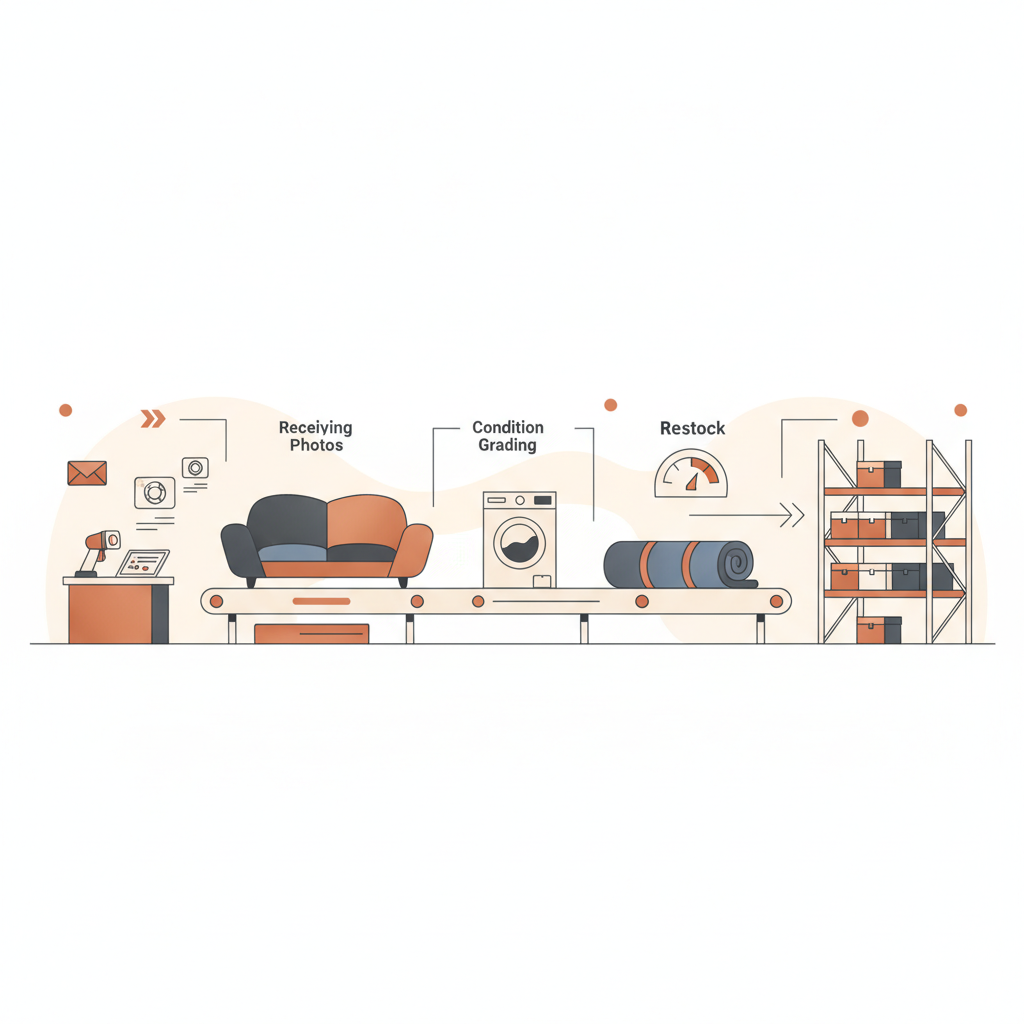
Partners evaluating whether to run their own node, or route volume through an existing one, should treat location economics as part of onboarding, not an afterthought. The node operator onboarding guide covers process and SLA setup, but the location question has to be answered first, because it sets the ceiling on what cycle time and cost per unit are even achievable. Every node, wherever it sits, still needs the same evidence standard: outer label, opened parcel, item, and defect photos, AI grading on the A/B/C/R scale with a confidence score, and disposition rules with operator overrides logged. That standard is what keeps grading consistent whether a return lands in East Hanover or a partner-run facility three time zones away. You can see what that evidence actually looks like at the evidence sample page, and compare cost structures across models at pricing.
For the broader framework on reselling returns processing capacity and setting up multi-tenant operations, the partner playbook hub is the place to start before narrowing down to a specific location decision.
Frequently asked questions
How much does facility location actually change the cycle time?
It depends on the gap between the customer and the node, but transit time is often the single largest variable outside of the facility's own processing speed. A node positioned near dense population and carrier hubs can hold a 48 hour median cycle from scan to disposition more consistently than one that depends on long-haul inbound freight before grading can even begin.
Is a single large facility always cheaper than multiple regional nodes?
Not necessarily. A single hub usually has lower facility overhead per unit, but it can lose that advantage once freight cost and markdown decay from longer transit are added in. The right model depends on how spread out your return volume actually is.
Does areturnz operate more than one facility?
NJ-01 in East Hanover, New Jersey is the facility referenced across our published figures, including the 48 hour median cycle and 99.6% AI-vs-operator match accuracy across 180K+ returns processed. Partners extending coverage beyond that footprint do so through the white-label node model, which applies the same evidence and grading standard regardless of location.
What should a partner model before committing to a new node location?
Freight cost in both directions, days to disposition including inbound transit, local labor and facility overhead, and whether regional return density matches the planned facility size. Skipping any one of these usually produces a cost-per-unit number that looks better on paper than it performs in practice.
Does grading accuracy change by facility location?
It should not, and that is the point of standardizing on shared AI grading with a confidence score and logged operator overrides. Location changes transit and cost. It should never change whether a B-grade item gets called a B-grade item.
If you are weighing a new node location or evaluating regional coverage for your return volume, talk to areturnz about facility footprint and what the numbers would look like for your specific lanes.