Autonomous Disposition: When AI Grading Skips the Human Review Queue

Autonomous disposition is the point at which a returns network lets AI grading output, not a person, decide what happens to an item next: restock, liquidate, donate, or destroy. At areturnz, that decision fires automatically once a grade clears a confidence threshold, and it's checked against a 99.6% AI-vs-operator match rate across more than 180,000 processed returns. The human review queue doesn't disappear. It just stops being the default stop for every parcel.
What changes when a grade skips review
In a manual model, every returned item waits for a person to look at photos, read the grade, and confirm or override it before disposition happens. That queue is where most of the 48 hour median cycle used to get spent, because even a fast reviewer is still a bottleneck when volume spikes on a Monday after a holiday weekend.
Autonomous disposition removes that wait for the items the model is sure about. A grade A phone case with a clean outer label photo, an opened-parcel photo showing original packaging, and a confidence score north of the set threshold gets routed to restock the moment grading finishes. No queue, no ticket, no operator click. The item moves because the evidence already answered the question.
How the threshold actually decides who reviews
Every grade a model produces carries a confidence score, not just a letter. A, B, C, and R describe condition; the score describes how sure the model is about that label given the photo evidence it captured at receiving. Autonomous disposition rules watch that score, not the grade alone, because a grade B item graded at 98% confidence is a very different case than a grade B item graded at 61% confidence.
| Confidence tier | Typical action | Human involvement | Common grades seen |
|---|---|---|---|
| High (above set threshold) | Auto-disposition fires immediately | None at time of routing; spot-audited after the fact | A, B, R (clear-cut cases) |
| Mid-range | Routed to operator review queue | Operator confirms or overrides before disposition | B, C |
| Low or flagged tags | Held for manual grading from scratch | Full operator review, override logged | Any grade with damage-ambiguity tags |
| Contractual exception (brand rule) | Always routed to review regardless of score | Operator review required by tenant policy | High-value SKUs, recalled items |
Thresholds aren't fixed across every tenant or category. A brand selling electronics might set a tighter threshold than one selling t-shirts, because the cost of a wrong autonomous call is higher on a $400 item than a $22 one. That tuning work is the same calibration discipline covered in confidence calibration, just applied one layer up, at the disposition rule instead of the individual grade.
Where autonomous disposition earns its keep
High-volume, low-ambiguity categories
Apparel returns with clear damage tags, unworn folded items, and consistent packaging patterns are where autonomous disposition does the most work. The visual signal is strong and repeatable, so confidence scores cluster high, and the model rarely needs a second opinion.
Categories where the model still asks for help
Electronics with functional defects that don't show up in a photo, beauty products where seal integrity matters more than surface appearance, and anything flagged with an ambiguous tag still route to the review queue. The category-specific behavior of the grading model is detailed in grading apparel vs electronics vs beauty, and it's the same logic that decides which items are candidates for autonomous rules at all.
What happens when an autonomous call turns out wrong
No threshold is perfect, and a 99.6% match rate means roughly four calls in a thousand still land differently than an operator would have called them. Autonomous disposition doesn't try to hide that math; it audits it. A sample of auto-dispositioned items gets pulled for operator review after the fact, and any mismatch gets logged the same way a live override would be. That process is the same one described in false-positive handling, just running as a retrospective check instead of a live gate.
The disposition rules themselves, the ones that map a grade and confidence score to restock, liquidate, donate, or destroy, are covered in more depth in disposition rules: turning grades into decisions. Autonomous disposition is really just those rules running without a pause for human sign-off on the cases that clear the bar.
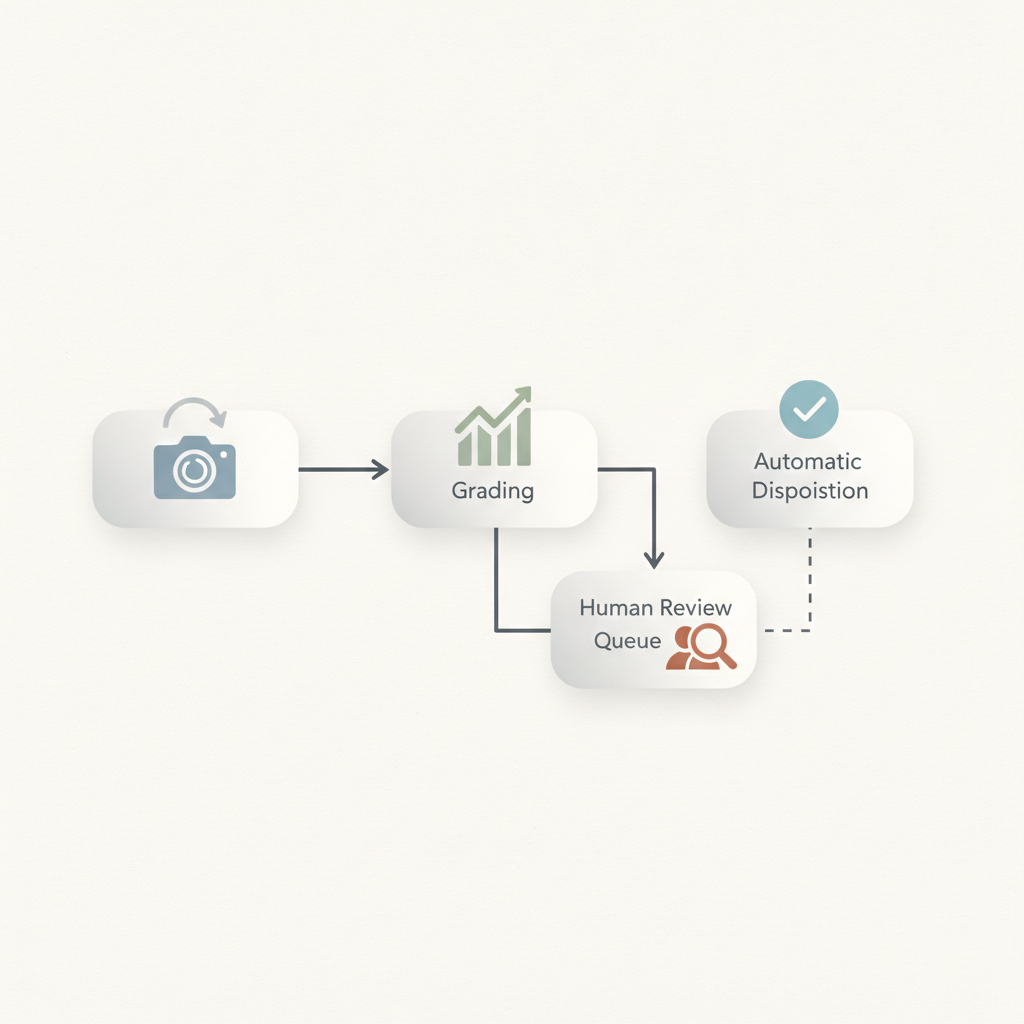
The audit trail behind every autonomous call
Skipping the review queue doesn't mean skipping the evidence. Every autonomously dispositioned return still ships with the same evidence bundle as a manually reviewed one: the outer label photo, the opened-parcel photo, the item photo, any defect photo, the grade, the confidence score, and detected tags. That bundle is available in the dashboard and through the signed-JSON API with webhooks, and it's exactly what a brand or partner pulls up if a dispute comes in later.
You can see what that bundle actually looks like at the evidence sample page, which is worth reviewing before turning on any autonomous rule, since the whole point of automating disposition is that the paper trail has to hold up without a person having eyeballed the call in real time.
Setting up autonomous disposition without losing control
Turning on autonomous disposition isn't a single switch. It starts with picking categories and grades where confidence scores already cluster high and consistent, setting a threshold above that cluster, and running it in shadow mode first, where the model makes the call but an operator still checks it, before letting it run live. Most tenants tighten thresholds for high-value SKUs and loosen them for high-volume, low-value categories, which is also where the pricing model tends to reward faster cycle times most directly.
This whole approach sits inside the broader grading system covered in the AI condition grading pillar guide, which walks through how the A/B/C/R scale, confidence scoring, and disposition rules fit together before automation gets layered on top.
Frequently asked questions
Does autonomous disposition replace operators entirely?
No. It removes the review step only for the returns where confidence clears a set threshold. Mid-confidence and flagged items still route to a person, and every automated call is still subject to spot audits and logged overrides.
What confidence score triggers an autonomous decision?
It varies by tenant, category, and item value. A brand can set a tighter threshold for electronics than for apparel, and thresholds get recalibrated as the model sees more volume in a given category.
How does autonomous disposition affect cycle time?
It's one of the biggest levers behind the 48 hour median cycle from inbound scan to disposition, since high-confidence items skip the queue entirely instead of waiting for the next available reviewer.
What proof exists if an autonomous call is later disputed?
Every return, automated or manually reviewed, ships with the full photo evidence bundle, grade, confidence score, and detected tags, available via dashboard or signed-JSON API with webhooks.
Can a brand require manual review for certain items regardless of confidence?
Yes. Contractual exceptions can force manual review for specific SKUs, categories, or value thresholds, and those rules sit above the autonomous logic rather than replacing it.
If you want to see where autonomous disposition could safely apply inside your own return volume, talk to areturnz about running it in shadow mode against your current categories first.
Related reading: AI Condition Grading: The Complete Guide to ABCR at areturnz
Prova em cada devolução
Fotos, uma avaliação de condição por IA e uma cadeia de custódia completa, anexadas a cada encomenda e disponíveis via API.


