Designing a Holiday Return Window Policy That Does Not Eat Your Margin

A holiday return window policy is the set of rules that decides how long a customer has to send back a gift-season purchase, and how that extended timeline gets reconciled against restock speed, reserve accounting, and disposition capacity so the extra goodwill does not quietly become an extra cost center. areturnz treats the policy as an input to its disposition engine rather than a marketing afterthought: the window you publish on your site determines when a parcel enters the network, and that start date sets the clock on everything downstream.
What a holiday return window policy actually controls
Most retailers write the policy as a customer-facing promise: "buy between November 1 and December 24, return anytime through January 31." That sentence looks simple, but it quietly controls three operational variables at once. It sets how long inventory sits in limbo before it can be graded and restocked. It determines how big the reserve line on your balance sheet needs to be during the highest-volume quarter of the year. And it decides how much of your returns volume arrives compressed into a two-to-three week spike right after the holidays, instead of spread evenly across ten weeks.
Retailers who treat the window purely as a customer experience lever tend to get surprised by the January spike. The policy is generous on paper, so shoppers wait until the last week to act, and a facility that handled 400 returns a day in November suddenly needs to handle 1,800 a day in the second week of January. If your grading and disposition capacity does not flex with that curve, the backlog itself becomes the margin problem, independent of the return rate.
The margin math behind extended windows
Every extra week you add to a holiday window has two effects that pull in opposite directions. It raises conversion and reduces buyer's remorse at checkout, because shoppers trust they will not be stuck with an unwanted gift. But it also raises average shelf age for anything that eventually gets returned, and shelf age is the thing that actually erodes margin. A sweater returned on December 28 can often go back on a shelf or into a resale channel before the next markdown cycle. A sweater returned on February 3, six weeks after the extended window closes, is fighting a much steeper markdown curve and a shrinking resale window for the season.
This is the same tension covered in markdown decay versus restock speed: the value of an item decays on a schedule that does not care about your return policy. A holiday window that is generous to the customer but slow to route items back into a grading queue is effectively choosing decay over recovery.
| Window design | Customer effect | Margin effect | Operational risk |
|---|---|---|---|
| Standard 30-day window, no holiday extension | Lower perceived flexibility, some checkout hesitation in November | Fast turns, minimal shelf-age decay | Low, volume stays spread out |
| Extended window to mid-January | Higher gift-purchase conversion | Moderate decay on late-window returns | Moderate, predictable spike in early January |
| Extended window to end of January or later | Highest perceived flexibility | Significant decay risk on the last 2-3 weeks of returns | High, compressed backlog if grading capacity is fixed |
| Category-tiered window (electronics 14 days, apparel to January) | Clear expectations by category | Protects margin on fast-decaying categories | Low if communicated clearly at checkout |
Designing tiers by category and channel
A single blanket window across every SKU is the easiest policy to write and the hardest one to defend financially. Electronics and beauty items lose resale value fast once the season passes; a holiday-specific electronics accessory or limited beauty set can be nearly worthless by February. Apparel and home goods decay more slowly and often have a longer resale runway. A tiered policy, shorter windows on fast-decaying categories, longer windows on durable goods, lets you keep the marketing promise of "generous holiday returns" while protecting the categories that actually need protecting.
Channel matters too. Marketplace and third-party sales often carry their own return rules imposed by the platform, and those can conflict with your own extended window if you are not careful. If you sell across multiple channels, work through marketplace-specific return handling separately from your direct-to-consumer policy rather than assuming one window fits both.
Where the 48 hour cycle changes the calculation
The reason an extended window does not have to be a margin drain is that the damage comes from time between return receipt and disposition, not time between purchase and return. If a facility takes ten days to log, grade, and route a returned parcel, the effective decay clock starts ten days after the customer ships it back. areturnz processes returns with a median cycle of about 48 hours from inbound scan to disposition, so a return that lands in the queue in the second week of January is graded and routed by mid-week, not sitting in a backlog through the end of the month.
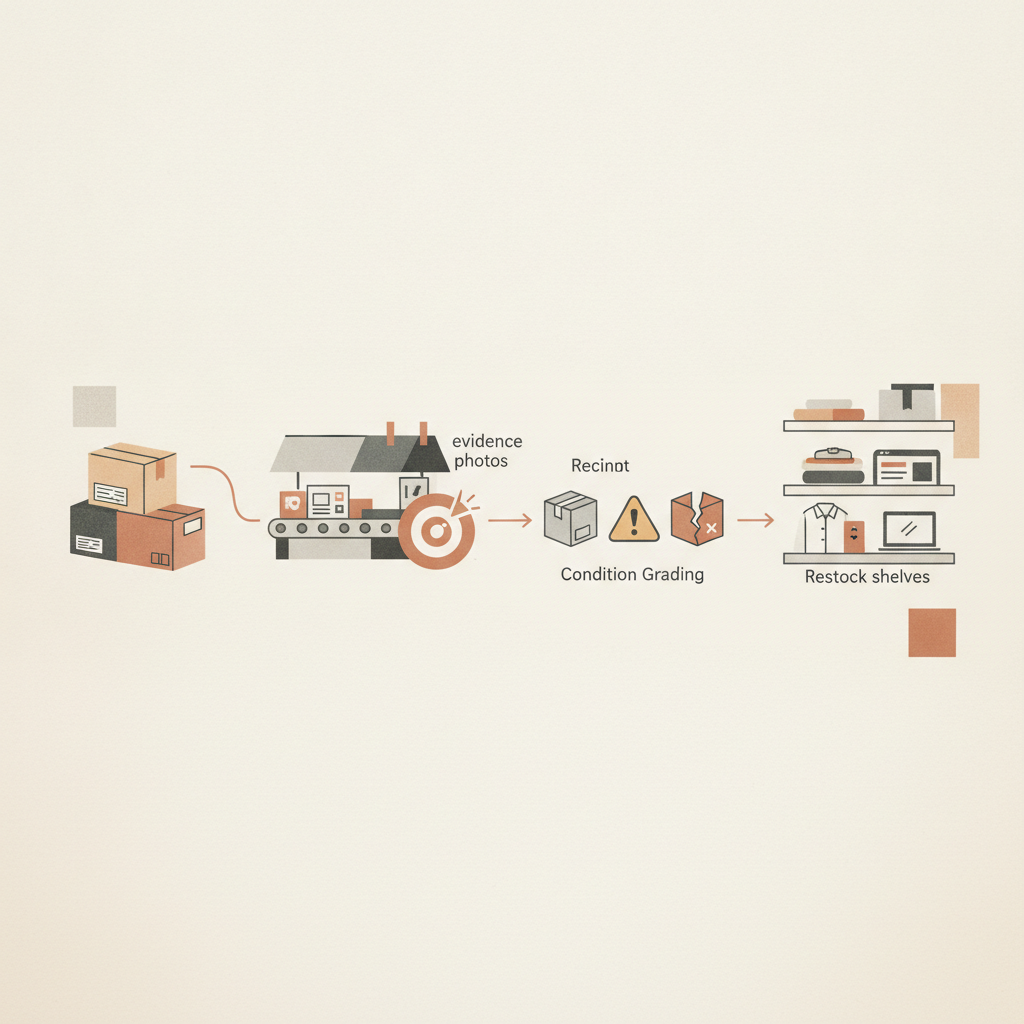
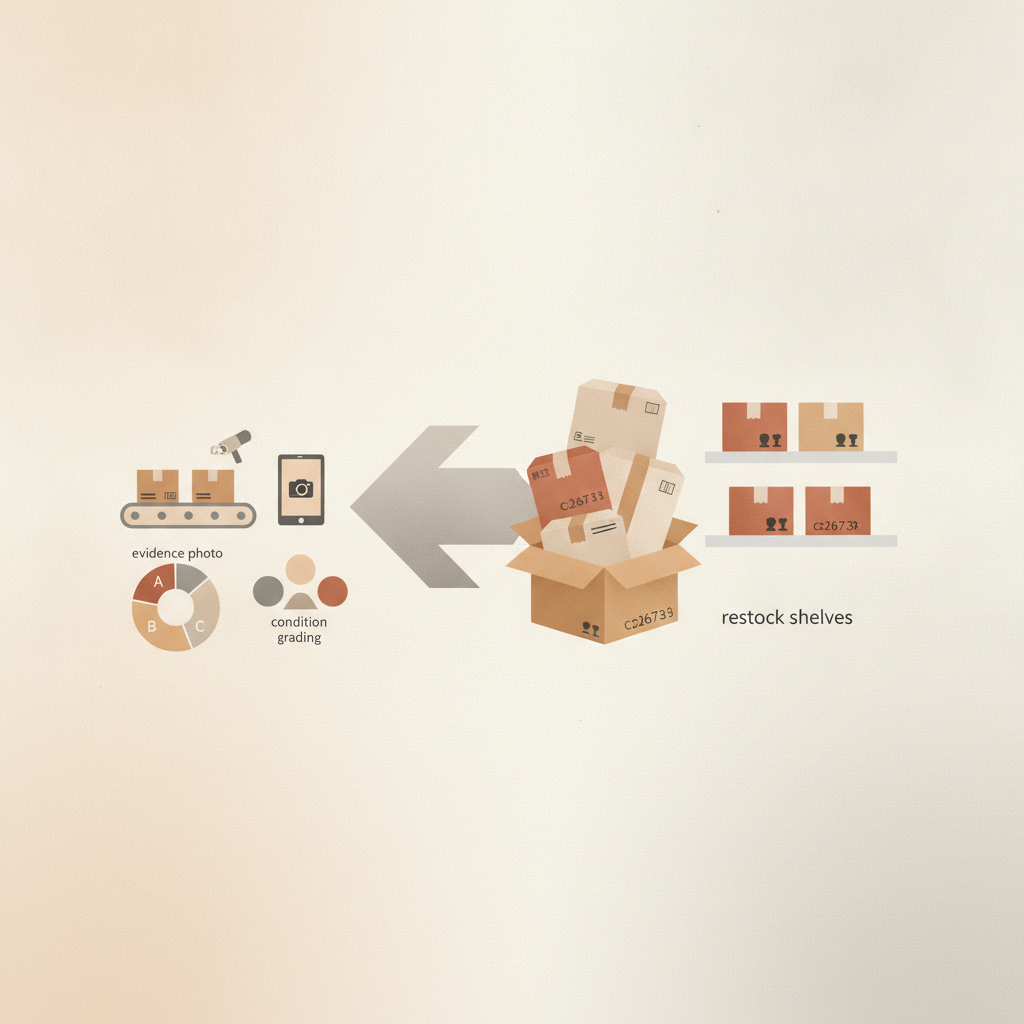
Every parcel is photographed at receiving (outer label, opened parcel, item, and any defect), then graded on the A, B, C, R scale with a confidence score and detected tags. AI-vs-operator match accuracy runs about 99.6% across more than 180,000 returns processed, which matters most during the exact weeks when volume spikes and manual review capacity is tightest. Disposition rules apply automatically once grading is confident, routing to restock, liquidate, donate, or destroy, with every operator override logged. That combination is what lets a retailer extend the customer-facing window without extending the operational one.

A sample holiday policy framework
The table below is a starting structure, not a universal answer. Adjust the day counts to your own markdown cadence and your facility's grading throughput.
| Category | Purchase window covered | Return deadline | Why |
|---|---|---|---|
| Electronics and holiday-specific tech accessories | Nov 1 to Dec 24 | 14 days after delivery | Fast decay, high resale value only while current |
| Beauty and seasonal gift sets | Nov 1 to Dec 24 | 21 days after delivery | Packaging and seasonal branding lose value quickly |
| Apparel and footwear | Nov 1 to Dec 24 | Jan 15 | Slower decay, strong resale channel through Q1 |
| Home goods and durable items | Nov 1 to Dec 24 | Jan 31 | Minimal seasonal decay, longest safe window |
Layering a tiered structure like this on top of a fast grading cycle is the practical version of the strategy laid out in returns reserve accounting: you can budget for the returns you have not received yet with more confidence when the window length and the disposition speed are both known quantities rather than moving targets.
Common mistakes that erode margin
The most common mistake is publishing one holiday window for the entire catalog and never revisiting it once it is decided in September. A close second is treating the January spike as a customer service problem rather than a capacity planning one, so the policy stays generous but the facility staffing and grading throughput do not scale with it. A third is failing to track restock velocity by category during the holiday window specifically, because the number that looks fine in an annual average can hide a January collapse. The restock velocity metric post covers how to track that number in a way that catches seasonal drops before they show up in quarterly margin reports.
Frequently asked questions
How long should a holiday return window be?
There is no single correct number, but a common pattern is a purchase window from early November through December 24, paired with a return deadline in mid-to-late January depending on category. Fast-decaying categories like electronics and beauty should get shorter deadlines than apparel or home goods.
Does an extended holiday window increase fraud risk?
It can, mainly because a longer window gives more time for wardrobing, wear-and-return, and mismatched item swaps to occur before the retailer can inspect the item. Photo evidence and chain of custody documentation on every parcel, covered in more detail in killing the item not as described dispute, are what let you extend the window without losing your ability to dispute questionable claims later.
Should the holiday window be the same across every sales channel?
Not necessarily. Marketplace channels often impose their own minimum return windows, and matching your direct-to-consumer policy exactly can create either a customer-facing inconsistency or an unnecessary give-away on channels where the platform already sets the floor. Review channel-specific rules separately, especially for marketplace and partner-run storefronts.
How does areturnz help with the January return spike specifically?
The median 48 hour cycle from inbound scan to disposition means a spike in volume does not automatically turn into a spike in backlog. AI grading with a 99.6% match accuracy against operator review keeps throughput consistent even when daily return counts triple, and disposition rules route graded items to restock, liquidation, donation, or destruction without waiting on manual queues to clear.
Where can I see what the evidence and grading actually look like?
A sample evidence bundle, including the photos captured at receiving and the grading output, is available at the evidence sample page. Pricing for processing volume during peak season is outlined at the pricing page, and partners building their own holiday SLA can start with the returns economics hub for the full set of margin-focused posts this one extends.
If you are finalizing this year's holiday policy and want to model what an extended window does to your reserve and restock numbers before you publish it, contact areturnz to talk through your category mix and current facility throughput.
Prova em cada devolução
Fotos, uma avaliação de condição por IA e uma cadeia de custódia completa, anexadas a cada encomenda e disponíveis via API.