In-House vs Outsourced Returns Processing: The Real Tradeoffs
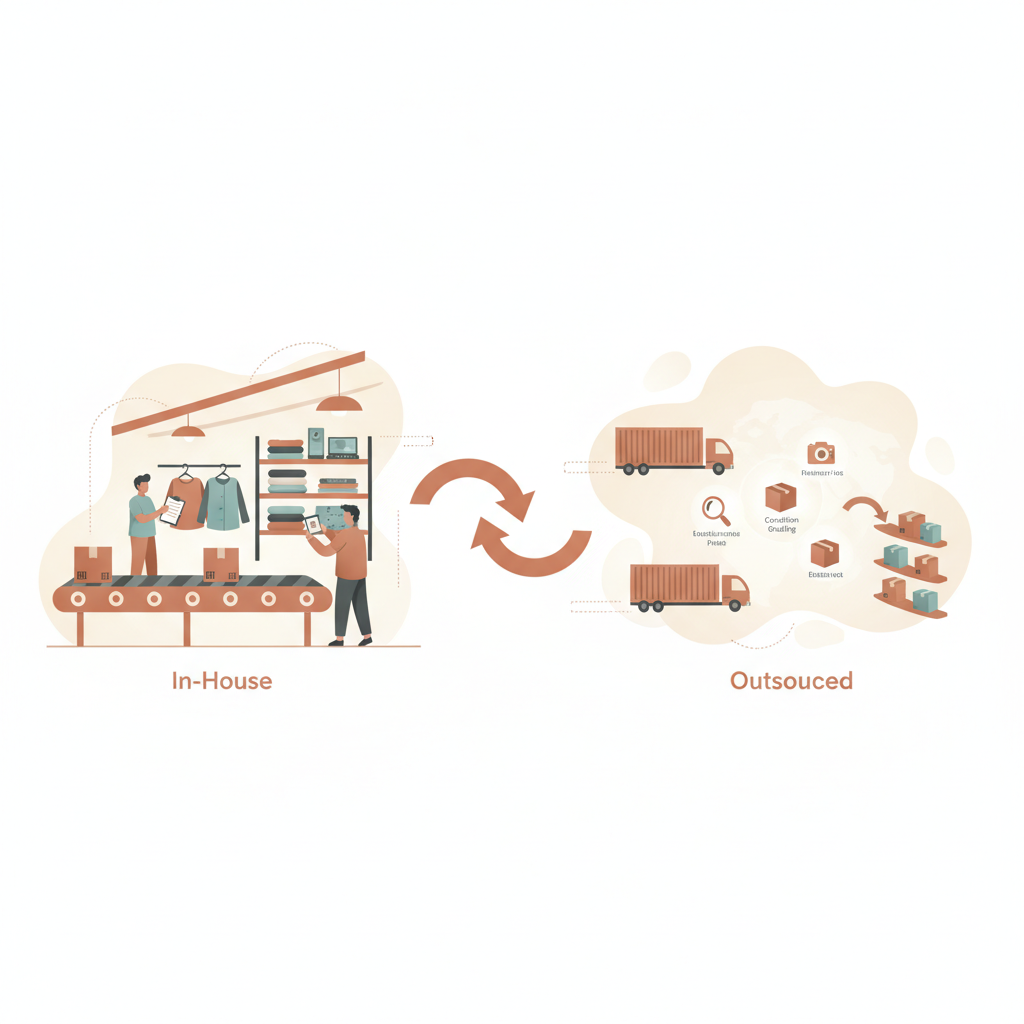
In-house vs outsourced returns processing comes down to a tradeoff between control and capacity: running returns internally keeps decisions and staffing under your own roof, while outsourcing to a dedicated network like areturnz shifts photo grading, disposition, and evidence generation to a facility built to do only that, at a documented 48 hour median cycle and 99.6% AI-vs-operator match accuracy across 180K+ returns processed. Neither option is universally right. The answer depends on volume, SKU complexity, and how much you actually value proof on every parcel.
Why this decision keeps getting revisited
Most retailers and brands started with in-house returns handling because it was simple: a receiving dock, a few employees, a spreadsheet. It works fine at low volume. It stops working the moment return rates climb past a few hundred units a week, or the moment a marketplace or wholesale channel starts sending SKUs with different grading rules. Teams that never touched outsourcing find themselves rebuilding the same evaluation every peak season, and the tradeoffs rarely get written down honestly. This article does that.
The real costs of keeping returns in-house
In-house returns processing looks cheap on a spreadsheet because the labor line is already inside payroll. The costs that do not show up on that line are the ones that matter:
- Idle labor between peaks. A team sized for December sits underutilized in March, and a team sized for average volume drowns in Q4.
- Inconsistent grading. Without a structured A/B/C/R condition scale and a confidence score behind each call, two employees will grade the same item differently, and that inconsistency shows up later as markdown surprises or wrongful liquidation.
- No evidence trail. When a customer or marketplace disputes a return outcome, an in-house team without photo documentation at receiving has almost nothing to point to. That gap is explored in depth in why every return should ship with proof.
- Slow disposition. Internal teams often batch decisions weekly instead of daily, which stretches the real cost of a return well past the refund itself.
None of this means in-house teams are incompetent. It means the fixed costs of building AI grading, chain-of-custody logging, and disposition routing internally are high, and most operations never reach the volume needed to justify building that stack from scratch.
What outsourcing actually changes
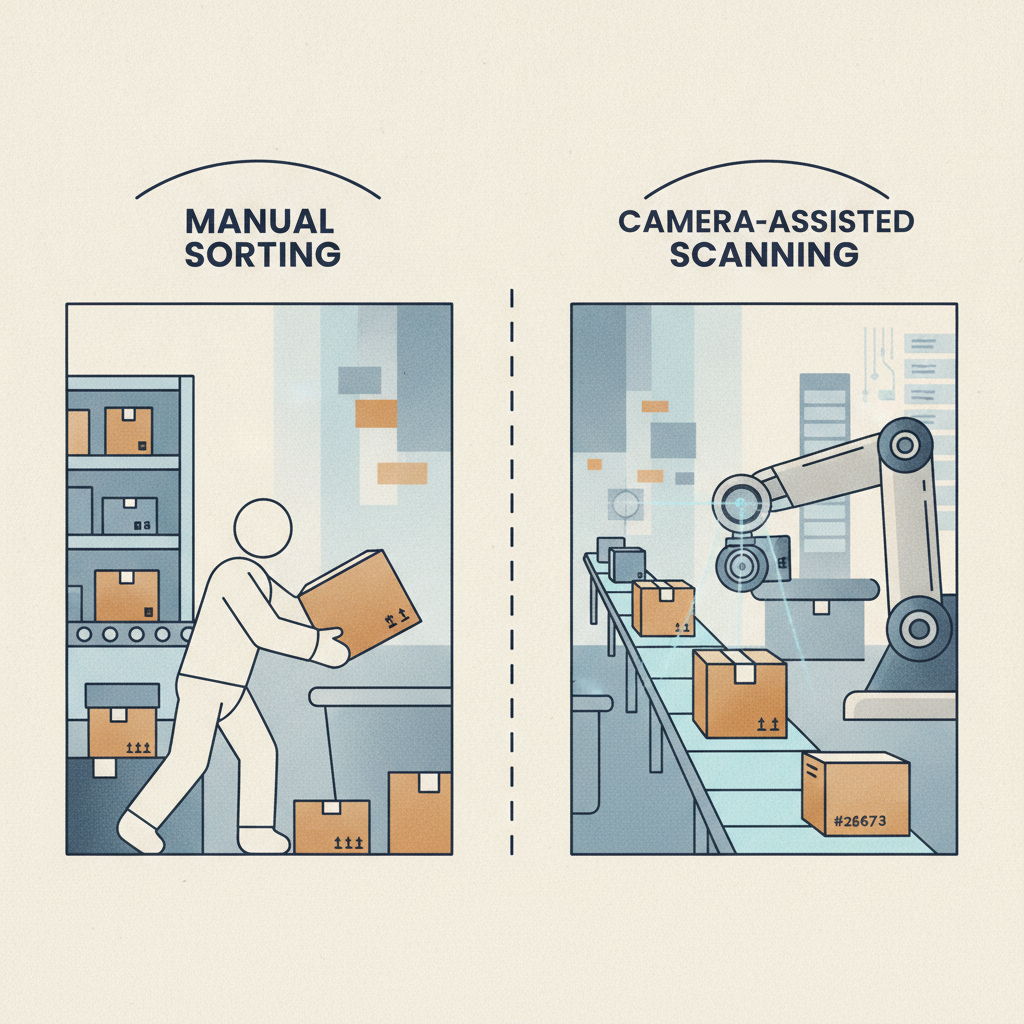
Outsourcing returns to a dedicated network changes three things at once: speed, consistency, and proof.
Speed
areturnz runs a median 48 hour cycle from inbound scan to disposition decision. That number holds because the facility (NJ-01 in East Hanover, New Jersey) is built around receiving and grading as the only job, not a side task squeezed between forward-logistics picks.
Consistency
Every unit gets graded on the same A, B, C, R scale with an AI confidence score attached. Operators can override a grade, but that override is logged, and the AI-vs-operator match rate sits at 99.6% across the network. That consistency is what makes restock and liquidation decisions defensible instead of guesswork, a topic covered in how AI condition grading actually works.
Proof
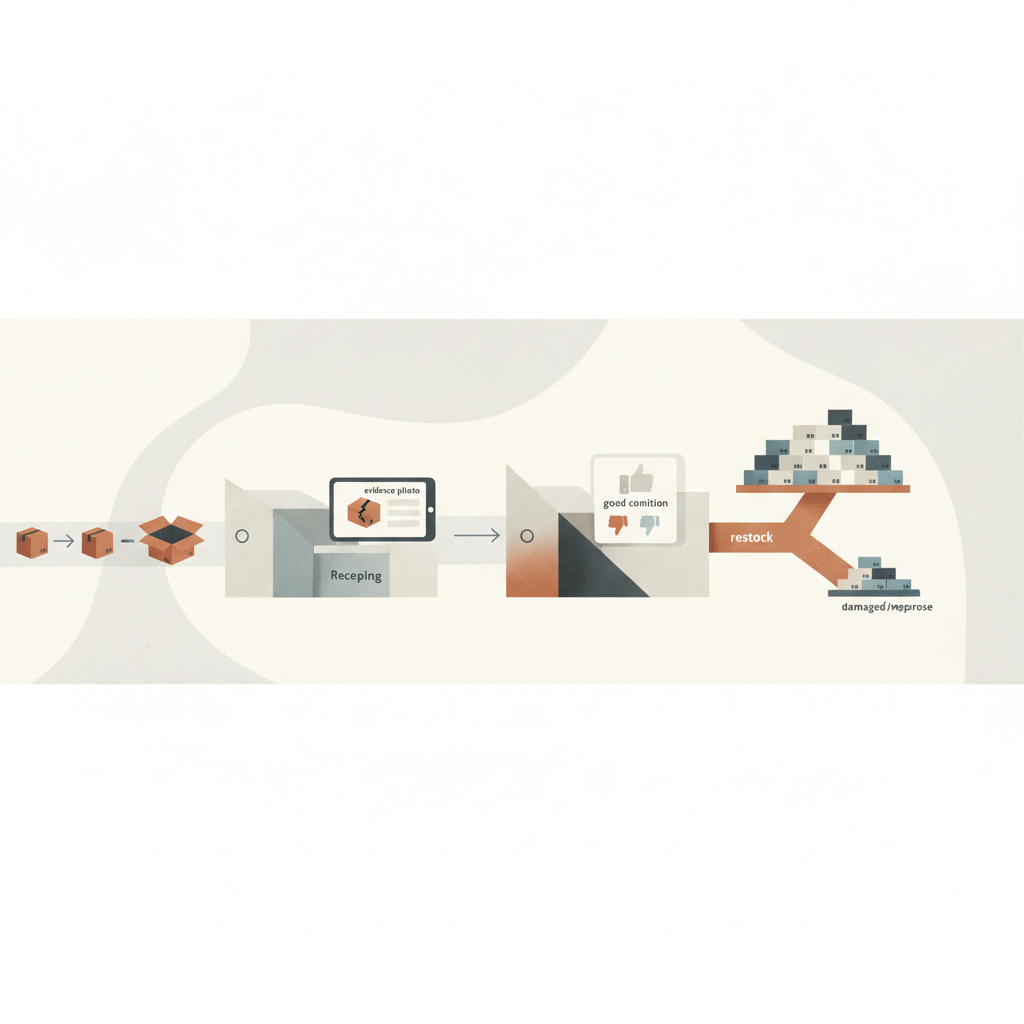
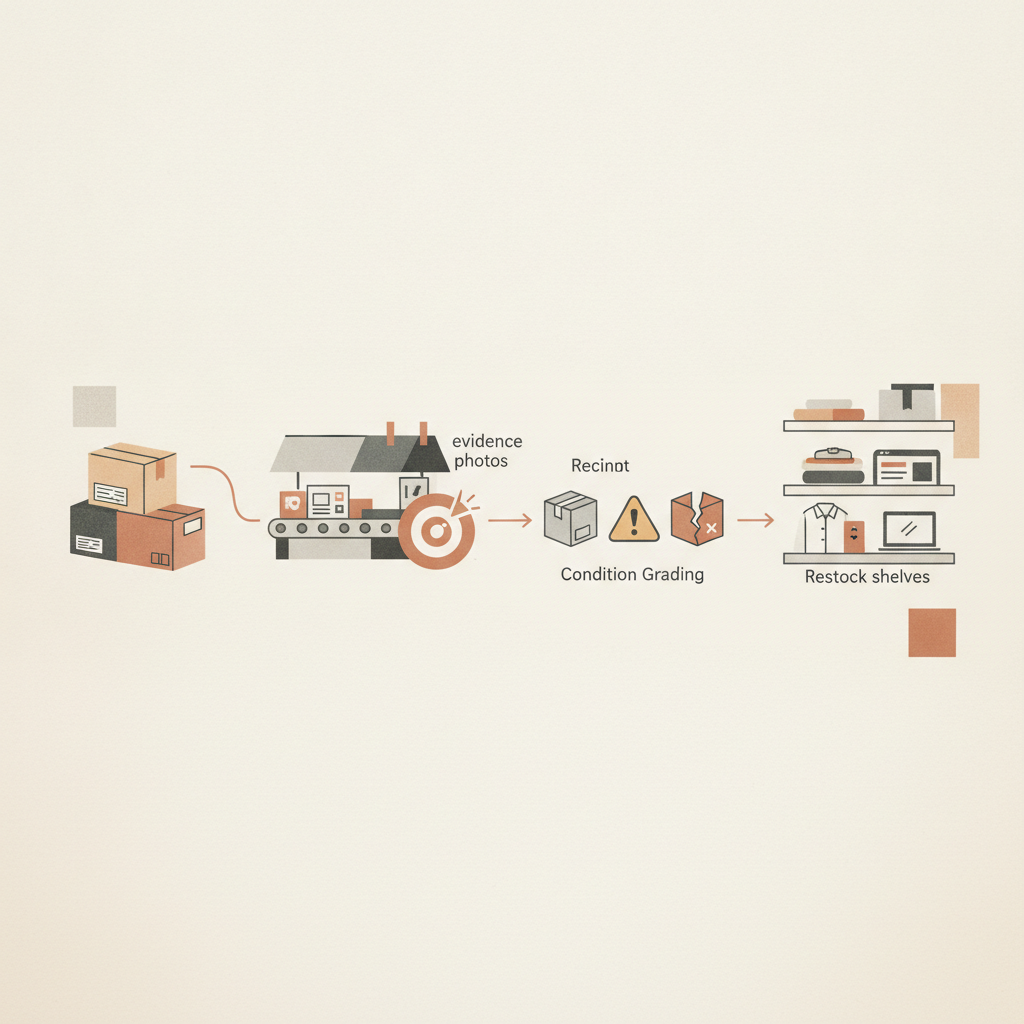
Every parcel is photographed at four points: the outer label, the opened parcel, the item itself, and any defect found. That bundle ships with every return, viewable in a dashboard or pulled through a signed-JSON API with webhooks. In-house teams rarely build this because it looks like overhead until the first serious dispute lands.
In-house vs outsourced: a side-by-side comparison
| Dimension | In-house returns team | Outsourced network (areturnz) |
|---|---|---|
| Staffing model | Fixed headcount, sized for average or worst case | Elastic capacity shared across the network |
| Grading consistency | Varies by employee, no confidence score | A/B/C/R grade plus AI confidence score, 99.6% match to operator review |
| Cycle time | Often 5 to 14 days, batched | About 48 hour median, inbound scan to disposition |
| Evidence per return | Rare, usually notes only | Photo evidence bundle: label, opened parcel, item, defect |
| Dispute defense | Weak, relies on memory or partial notes | Signed-JSON API and dashboard access to full evidence trail |
| Scalability for peak season | Requires hiring and training cycles | Absorbed by existing network capacity |
| Upfront investment | Facility, staff, software build | None, pay per return processed |
| Volume processed to date | Varies, unproven at scale | 180K+ returns processed across the network |
When in-house still makes sense
Outsourcing is not automatically correct. A brand with a very small return volume, extremely specialized items (custom fabrication, regulated pharmaceuticals), or a single-location retail footprint may find that a lean internal process is cheaper and faster to manage than integrating with an external network. In-house also makes sense when the item's condition assessment truly requires deep product-specific expertise that a general grading network has not yet built category rules for. The grading differences across apparel, electronics, and beauty show how much category nuance already exists in a mature grading system, which is worth checking before assuming your SKUs are too niche to outsource.
The hybrid model most operations actually land on
Very few large retailers go fully one way or the other. The common pattern is a brand keeping certain high-touch or regulated categories in-house while routing bulk apparel, general merchandise, or marketplace returns to a network like areturnz. This is where partner and node-operator structures matter: white-label resale, per-tenant reporting, and multi-tenant webhook isolation let a brand outsource operational volume while keeping its own reporting and customer-facing brand intact. That approach is detailed in the partner playbook content, which covers pricing, SLA design, and tenant onboarding for teams making this exact transition.
How to evaluate the switch without guessing
Before committing either way, pull three numbers from your current operation: average days from receipt to disposition, percentage of returns with any photo documentation, and current restock rate versus liquidation rate. Compare those against a documented external benchmark. You can review a live example of what a fully documented return looks like at the evidence sample page, and check pricing to see how outsourced cost per unit stacks against your fully loaded internal cost, including labor, software, and idle capacity during off-peak months.
Frequently asked questions
Is outsourcing returns processing more expensive than doing it in-house?
Usually not once idle labor, training, and dispute losses are counted. In-house teams often look cheaper on paper because software and evidence-capture costs are buried elsewhere in the budget or simply not built at all.
Can an in-house team match a 48 hour disposition cycle?
It is possible with heavy investment in scanning infrastructure and dedicated staff, but most in-house operations batch decisions weekly rather than daily, which stretches real cycle time well past 48 hours.
What happens to evidence and photos if we outsource?
Every parcel processed through areturnz is photographed at four points and the resulting bundle is available through the dashboard or a signed-JSON API with webhooks, so evidence is available on demand rather than requested after the fact.
Do we lose control of grading decisions by outsourcing?
No. Grades are assigned by AI with a confidence score and every operator override is logged, so the decision trail stays visible rather than disappearing into an internal team's private notes.
Can we outsource only part of our returns volume?
Yes. Many brands keep specialized or regulated categories in-house and route general merchandise or marketplace returns externally. This hybrid setup is common among partners using white-label and multi-tenant reporting structures.
If you are weighing this decision for an upcoming peak season or a channel expansion, talk to areturnz about what a hybrid or fully outsourced setup would look like for your actual return volume.
Related reading: 3PL Returns Add-on vs a Dedicated Returns Network: What Actually Changes