Shipped: AI Content and Quantity Verification on Receiving
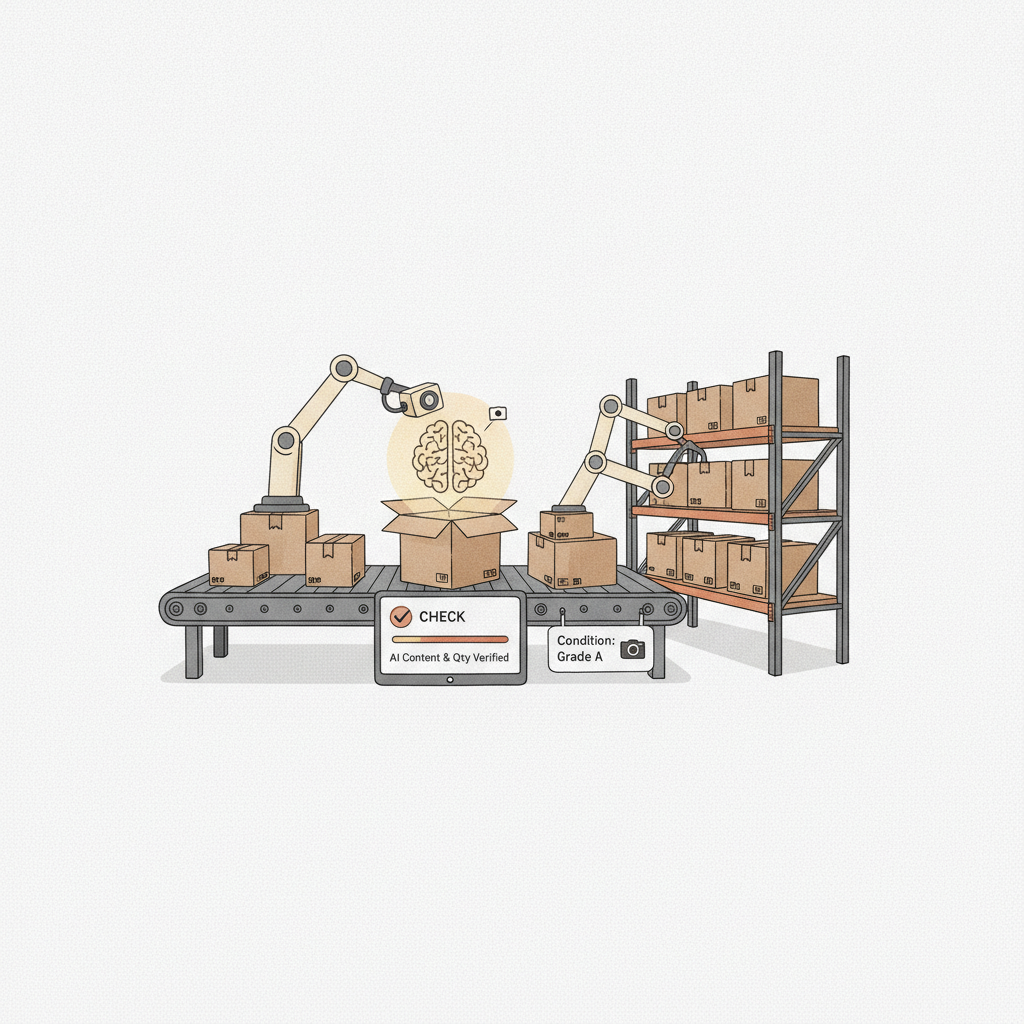
AI content and quantity verification is a receiving-line check inside areturnz that compares what actually arrives in a returned parcel against what the order record says should be there, confirming item identity, unit count, and included accessories before the parcel ever moves to condition grading. It is now live across the network, starting at facility NJ-01 in East Hanover, New Jersey, and it runs on the same photo capture that already documents every return.
This is a shipped-feature note, so we will keep it practical: what changed, why it matters for disposition accuracy, and how it plugs into the A/B/C/R grading and confidence-score work we have already written about.
What actually shipped
Every parcel that comes through receiving already gets photographed at four points: the outer label, the opened parcel, the item itself, and any visible defect. Content and quantity verification adds a fifth layer on top of that capture. The moment a parcel is opened, the model checks the photographed contents against the order line items and flags three kinds of mismatches automatically:
- Wrong item: the SKU photographed does not match the SKU on the return authorization.
- Wrong quantity: fewer or more units than the order calls for, including partial sets and multi-packs.
- Missing components: chargers, manuals, cases, or bundled accessories that are absent from the parcel.
Flagged parcels do not get auto-dispositioned. They get routed to an operator queue with the photo evidence and the specific mismatch called out, so a human confirms or overrides before anything moves further down the line. That override, like every grading override, gets logged.
Why this matters for disposition accuracy
Condition grading answers the question of what state an item is in. Content and quantity verification answers a different, earlier question: is this even the right item, in the right amount, with the right pieces. Getting that wrong upstream means a clean A-grade unit gets restocked missing its charger, or a two-pack return gets logged as complete when only one unit shipped back. Both scenarios create margin leakage that never shows up until a customer complains or a shelf count comes up short.
Since the AI-vs-operator match rate across the network already sits around 99.6% on grading calls, adding a verification pass before grading closes a gap that condition scoring alone was never built to catch. Median cycle time from inbound scan to disposition has held at roughly 48 hours through the rollout, and the network has now processed over 180,000 returns using the underlying photo and detection pipeline this feature extends.

How it fits with grading and confidence scores
Verification runs before grading, not instead of it. Once contents and quantity are confirmed, the parcel moves into the A/B/C/R condition grading flow described in our ABCR grading explainer, where the model assigns a grade and a confidence score the way it already does for every return. Low-confidence grading calls still route to a human reviewer, the same pattern covered in our post on confidence scores versus gut calls. Verification just adds a checkpoint that answers a question grading was never designed to answer on its own.
| Check | Question it answers | Where it runs | Outcome if flagged |
|---|---|---|---|
| Content verification | Is this the item the order says it is | At parcel opening, before grading | Routed to operator queue with photo evidence |
| Quantity verification | Are all ordered units and components present | At parcel opening, before grading | Routed to operator queue with photo evidence |
| Condition grading (A/B/C/R) | What state is the item in | After verification passes | Auto-dispositioned or routed by confidence score |
| Disposition rules | Restock, liquidate, donate, or destroy | After grade and confidence are set | Applied automatically, override logged |
What it looks like in the dashboard and API
Verification results show up as a distinct field in the evidence bundle for each return, alongside the grade, confidence score, and detected tags. Partners pulling data through the signed-JSON API get a webhook event when a mismatch is flagged, separate from the grading webhook, so downstream systems can decide whether a quantity or content discrepancy needs its own workflow. You can see the full structure of an evidence bundle, including how these fields are laid out, on the sample evidence page.
Rollout and what is next
Content and quantity verification is live now across the network and is being tuned category by category, since a multi-pack cosmetics return and a bundled electronics kit present very different verification problems. We are tracking flag rates by category over the next few reporting cycles and will publish accuracy numbers once we have a full quarter of data behind them. For the broader picture of what else has shipped recently, including photo evidence capture and the scan-to-search receiving rework, see the product updates hub.
Frequently asked questions
Does content and quantity verification replace condition grading?
No. It runs before grading and checks a different thing: whether the right item and the right quantity arrived, not what condition it is in. Grading still assigns the A/B/C/R score and confidence after verification passes.
What happens when a mismatch is flagged?
The parcel routes to an operator queue with the photo evidence attached and the specific mismatch noted. A human confirms or overrides the flag, and that decision is logged the same way grading overrides are logged.
Is this available through the API, not just the dashboard?
Yes. Verification results and mismatch flags appear in the evidence bundle and trigger their own webhook event, separate from the grading webhook, so partner systems can route them independently.
Which facility is this live at first?
Verification is live across the network now, and it launched first at facility NJ-01 in East Hanover, New Jersey, on the same photo capture infrastructure used for every return.
Does this change the 48 hour median cycle time?
Cycle time has held steady around 48 hours from inbound scan to disposition through the rollout. Verification adds a checkpoint, not a delay, since it runs on photos already being captured at receiving.
Want to see how content and quantity verification looks against your own return volume and SKU mix? Contact areturnz and we will walk you through it.
Related reading: Returns Processing Product Updates: What We've Shipped and Why
Related reading: Shipped: granular API keys for partner integrations


