areturnz vs an in-house returns team: an honest comparison
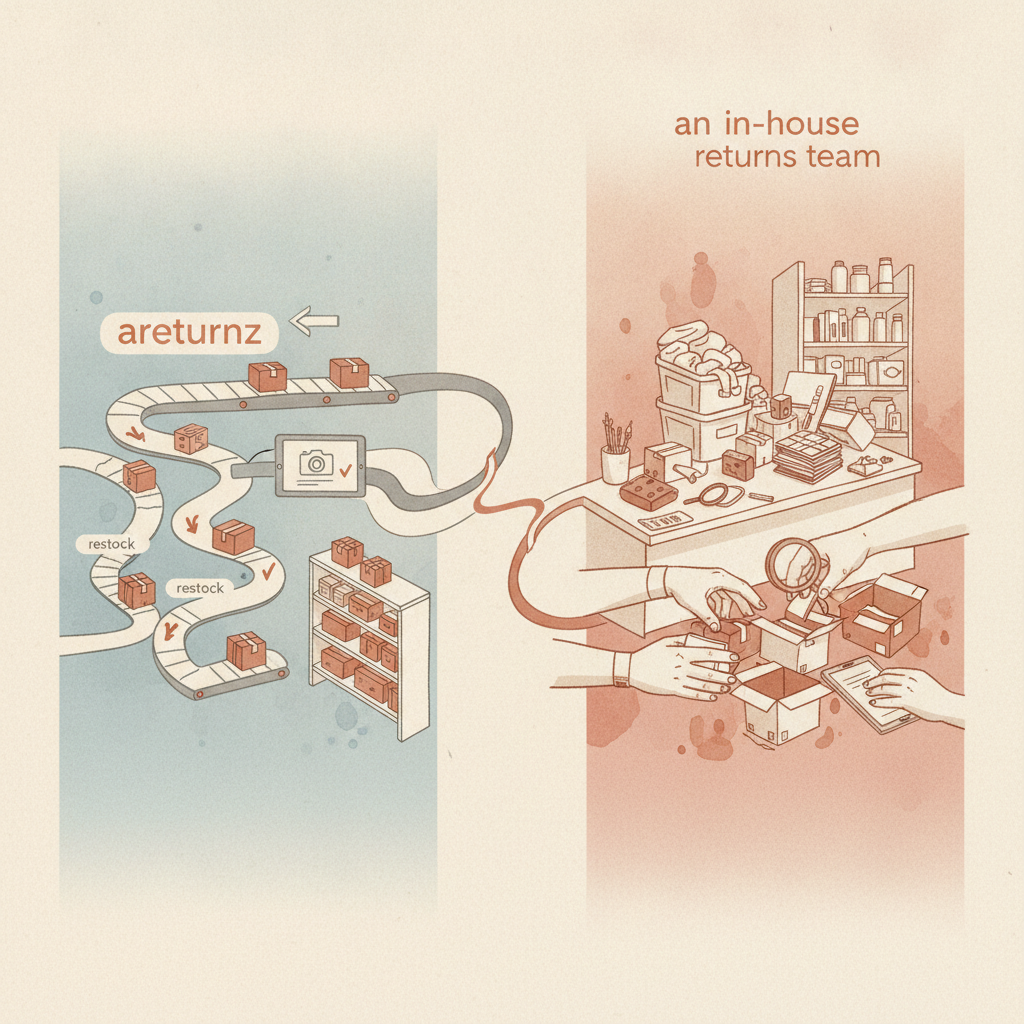
areturnz versus an in-house returns team comes down to one tradeoff: control over headcount and space versus a 48 hour median cycle, AI condition grading with a 99.6% match rate against operator review, and a photo evidence bundle on every parcel without building any of it yourself. areturnz is an owned-and-operated returns processing network, not a portal you bolt onto your website and not a 3PL that just forwards boxes. This article compares the two paths on cost, speed, accuracy, and what happens when a customer disputes a grade.
What an in-house returns team actually costs
Most retailers underestimate this because the cost hides across several budget lines instead of one. There is warehouse space carved out of a facility built for outbound, not inbound sorting. There is labor to receive, inspect, photograph (if anyone bothers), grade, and route each item. There is a supervisor layer to catch grading disagreements, and there is the software glue between the WMS, the liquidation partner, and whatever spreadsheet tracks disposition decisions. None of that shows up as a clean line item, which is exactly why returns quietly erode margin. We have written about this in detail in the real cost of a return and how it should be treated as its own P&L line rather than an afterthought of the refund.
The harder cost to quantify is inconsistency. Two inspectors grading the same jacket can land on different conditions depending on mood, lighting, or how busy the shift is. That inconsistency shows up later as inventory shrinkage, wrong markdowns, or resale disputes nobody can defend because there was no photo taken at receiving.
What areturnz does differently
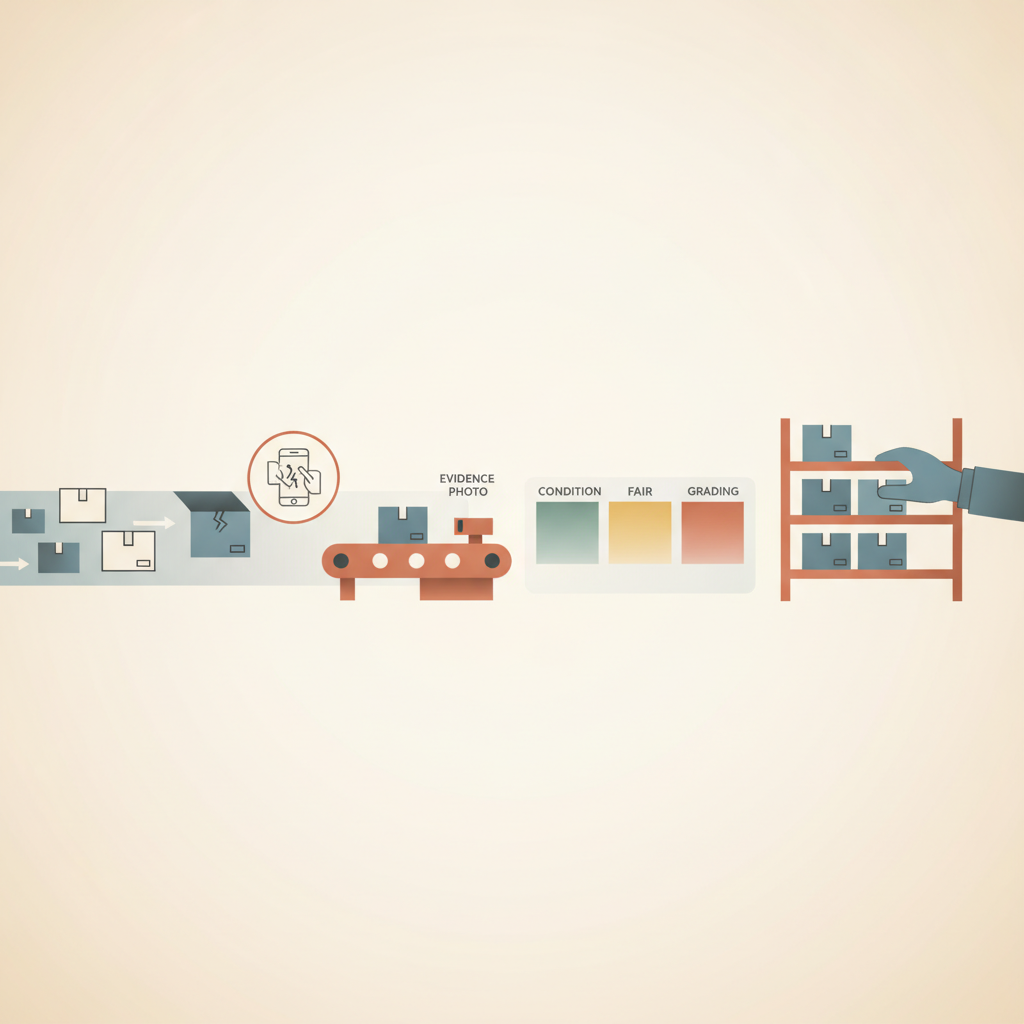
areturnz runs returns through a network built specifically for this workflow, starting at facility NJ-01 in East Hanover, New Jersey, and has processed 180K+ returns to date. Every parcel is photographed at four points: the outer label, the opened parcel, the item itself, and any defect found. An AI model grades condition on an A, B, C, R scale and attaches a confidence score, with detected tags describing exactly what it saw. Disposition rules then route the item to restock, liquidate, donate, or destroy, and any operator override is logged, not silently applied. The whole path from inbound scan to disposition runs on a median cycle of about 48 hours.
The AI-versus-operator match accuracy sits at about 99.6%, which means disagreements are rare enough that they become a data point rather than a daily fire drill. You can read the mechanics of how grading actually works in A, B, C, R: how AI condition grading actually works, and how disputes get closed with proof in why every return should ship with proof.
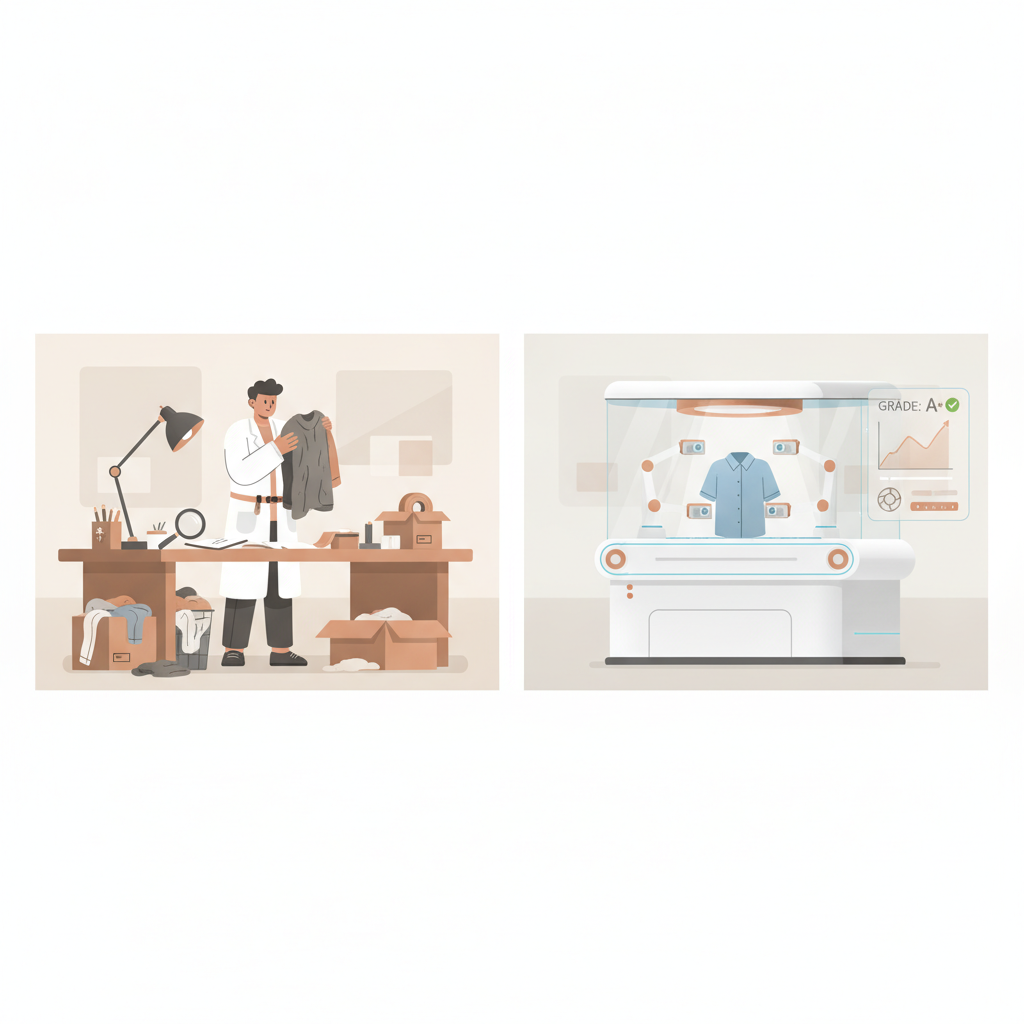
Side-by-side comparison
| Dimension | In-house returns team | areturnz |
|---|---|---|
| Median cycle time | Days to weeks, varies by staffing and season | About 48 hours from inbound scan to disposition |
| Grading consistency | Depends on inspector, shift, and training | AI grading (A/B/C/R) with about 99.6% match to operator review |
| Evidence per parcel | Inconsistent, often none | Photo evidence at four points plus a signed evidence bundle |
| Dispute defense | Manual notes, hard to produce quickly | Dashboard and signed-JSON API with webhooks, ready on request |
| Scaling for peak season | Requires hiring, training, temp space | Shared network capacity absorbs volume swings |
| Setup investment | Facility buildout, WMS integration, hiring | Onboarding onto an existing network |
| Fixed cost exposure | High, staff and space regardless of volume | Usage-tied, scales with actual return volume |
When in-house still makes sense
This is not a case where one option wins for every business. A retailer with very low return volume, a single SKU category, and no resale ambitions might genuinely be fine with a small back-room process. If your returns are almost entirely restockable with no grading nuance (say, sealed unopened boxes), the case for outsourcing weakens. In-house also makes sense if regulatory or contractual terms require the item never leave a specific building, though even then a node-style model can sometimes satisfy that constraint. See the node spec for how that works in practice.
Where in-house tends to break down is at the edges: peak season spikes, categories that need nuanced grading (apparel, electronics, beauty each grade differently, as covered in grading apparel vs electronics vs beauty), and any situation where a marketplace or payment processor demands proof for a disputed return. Those are the moments an in-house team either scrambles or simply cannot produce evidence fast enough.
What partners and brands ask before switching
The most common question is whether outsourcing means losing visibility. It does not. Every return still ships with an evidence bundle, viewable in a dashboard or pulled via signed-JSON API with webhooks, so a brand can audit any decision without waiting on a phone call. You can see what that evidence actually looks like at the evidence sample page. The second question is pricing, since finance teams want to compare it against current headcount cost; the pricing page breaks that down. The third question, usually from partners reselling returns processing themselves, is whether they can white-label the whole thing under their own brand, which is covered in the white-label returns platform playbook and the broader partner playbook hub.
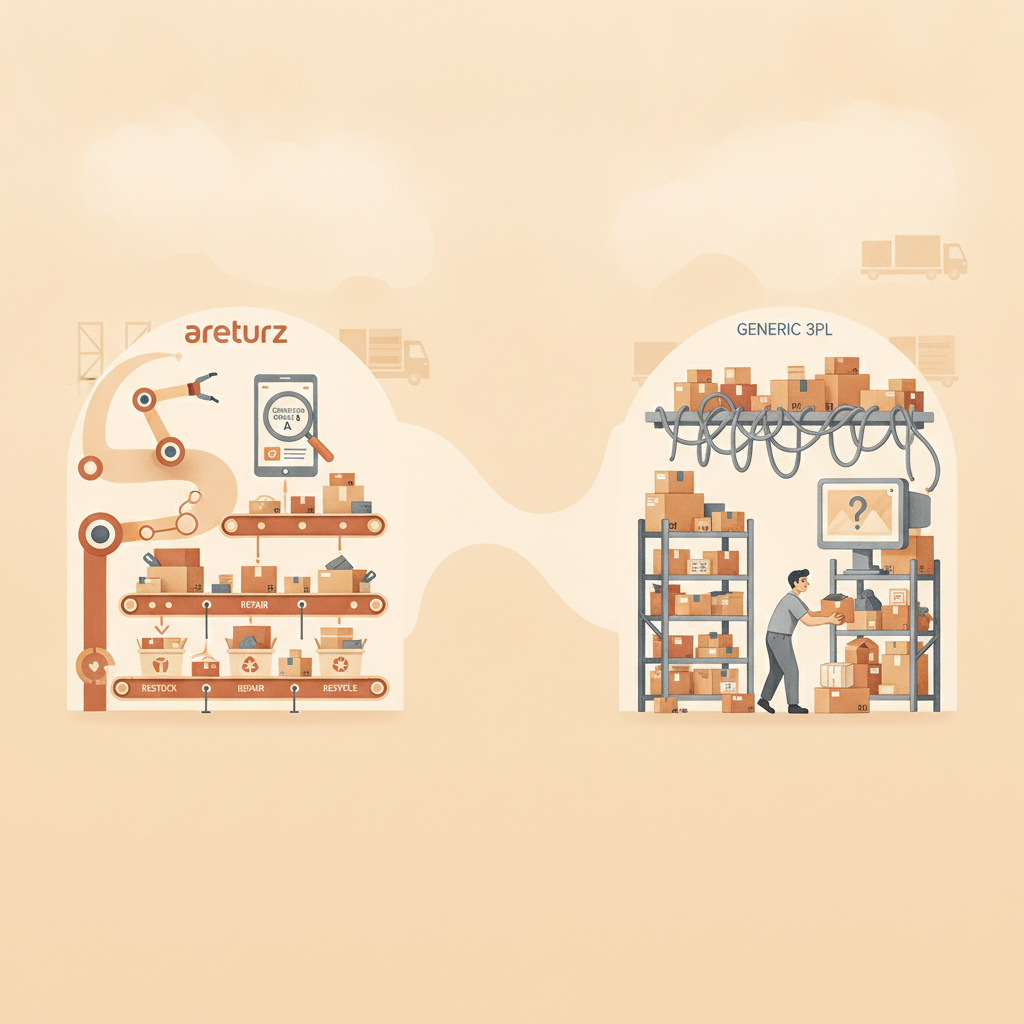
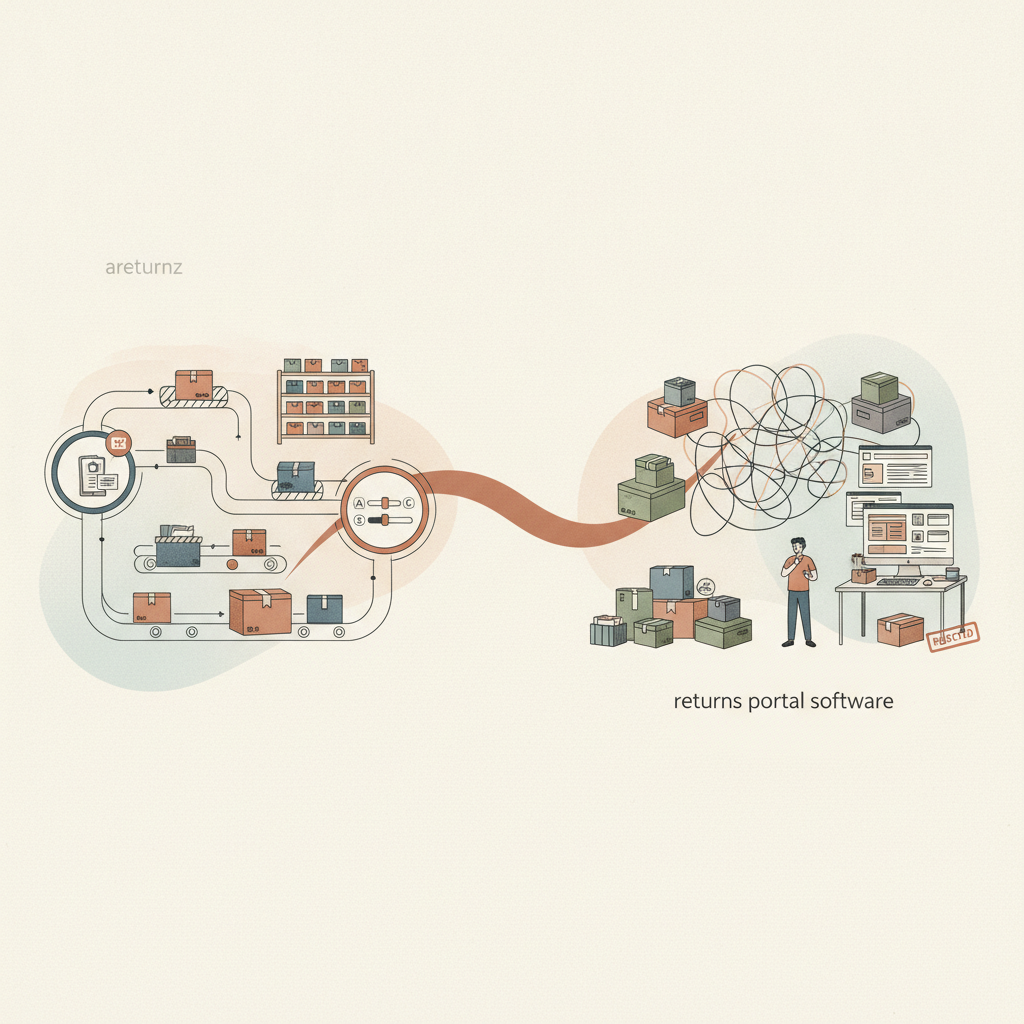
For brands specifically weighing this decision against other paths, the partners use case page lays out how the model differs from portal software and generic 3PL add-ons.
Frequently asked questions
Is areturnz cheaper than running returns in-house?
It depends on volume and category mix, but the comparison usually favors areturnz once you count warehouse space, hiring, training, and the cost of inconsistent grading. The fixed costs of an in-house team do not flex with return volume, while a network model scales with actual throughput.
Can we keep some returns processing in-house and route the rest to areturnz?
Yes. Many brands keep simple, sealed-box restocks in-house and route anything needing grading nuance, liquidation, or dispute defense through the network. Disposition rules can be tuned per category, per tenant.
How fast is areturnz compared to a typical in-house queue?
The median cycle from inbound scan to disposition is about 48 hours. In-house queues vary widely, often stretching to a week or more during peak season when staffing cannot keep pace with volume.
What happens if the AI grade is wrong?
Every AI grade carries a confidence score, and low-confidence items route to operator review. Overrides are logged, not silent. The AI-versus-operator match rate sits at about 99.6%, and the small remainder is handled by a human with the photo evidence in hand.
Do we lose evidence and audit trail by outsourcing?
No, it improves. Every parcel is photographed at four points and every disposition decision is tied to a chain of custody record, available through the dashboard or API. That is often more evidence than an in-house process produces today.
If you are weighing this decision for an upcoming budget cycle or a peak season crunch, talk to areturnz and bring your current cost numbers. We will show you where the 48 hour cycle and the evidence bundle actually land on your P&L.
Related reading: areturnz vs a Generic 3PL Returns Add-On: An Honest Comparison
Prova em cada devolução
Fotos, uma avaliação de condição por IA e uma cadeia de custódia completa, anexadas a cada encomenda e disponíveis via API.